
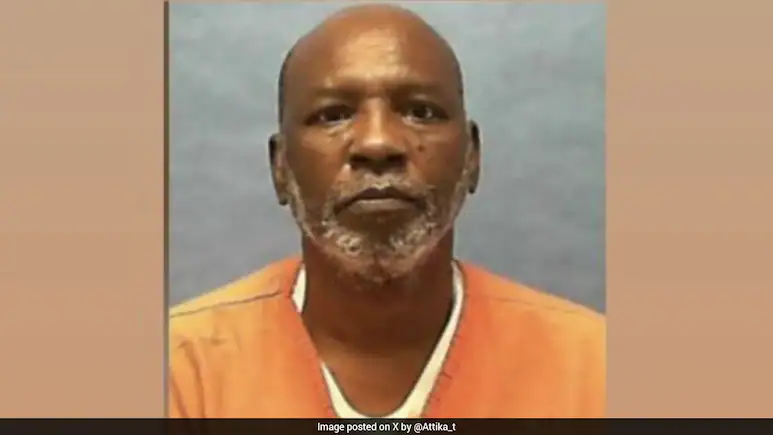
Florida carried out its 18th execution of the year on Tuesday under Republican Gov. Ron DeSantis ‘ aggressive use of the death penalty in his final term.
Asked if he had any last words, he replied ”No, I do not. The injection began immediately after that. After a few minutes, the team warden shook Reaves’ shoulders and shouted his name, but there was no response. A medic was called in a short time later to check for a heartbeat or any other signs of life, and Reaves was pronounced dead about a minute later. “That’s not justice in any way in my opinion. Reaves later acknowledged he had placed the call from a payphone outside the store. They then struggled over the weapon, and Reaves eventually regained control of it. Raczkoski died later that day from his wounds.
William Reaves, 77, was pronounced dead at 6:12 pm following a three-drug injection at Florida State Prison near Starke. He was convicted of first-degree murder in the September 1986 shooting death of Indian River County sheriff’s deputy Richard Raczkoski. The death chamber curtain went up promptly at the 6 pm execution time with Reaves already strapped to a gurney with an IV in his arm. About 30 seconds later, Reaves took several big breaths and then stopped moving. Reaves was the eighth Florida prisoner over age 70 put to death this year, highlighting the nation’s aging death-row population as Florida continues to far outpace the rest of country in total executions. Last year, Florida set a state record with 19 executions in a year, and it’s poised to tie that mark if another execution is carried out next month as scheduled. Raczkoski responded to a 911 call at a Vero Beach convenience store on Sept. 23, 1986, according to court records.
DeSantis, who leaves office in January after two terms, has said he wants justice to be delivered to victims’ families who have often waited decades for death sentences to be imposed. Marc Raczkoski, the deputy’s brother, briefly told reporters after witnessing the execution that his brother finally got justice. But Indian River County Sheriff Eric Flowers, who was also on hand, said at a post-execution briefing that he saw the execution as closure, not justice. “Would we all be so lucky to be 77 years old and to die so peacefully,” Flowers said. a gun fell out of Reaves’ shorts, officials said While the two men talked. Investigators said the deputy was trying to run away when Reaves shot him four times.
The US Supreme Court on Tuesday afternoon rejected Reaves’ 11th-hour appeal without comment. Reaves was convicted and sentenced to death about a year after the shooting. Subsequent appeals were unsuccessful. The Florida Supreme Court last week also rejected Reaves’ appeals seeking to spare his life. His attorneys challenged Florida’s three-drug lethal injection protocol. In July, Florida executed two prisoners in one day, becoming the first state in nearly a decade to do so. On Nov.
Because of a conflict of interest with the prosecutor and ordered a new trial, but the Florida Supreme Court overturned the conviction. Because of post-traumatic stress disorder stemming from his service in the Vietnam War, reaves’ attorneys also argued that jurors who recommended the death penalty were never told the US Department of Veterans Affairs had rated the Army veteran as 100% disabled. Reaves was convicted again and newly sentenced to death in 1992. More than 100 military veterans appealed to DeSantis to halt the execution in a letter Monday, citing those factors. A total of 47 people were executed in the United States in 2025. Florida led the nation that year with 19 executions and has accounted for more than half of the 32 US executions — Reaves included — carried out thus far in 2026. 5, Jesse Guardado, 64, is scheduled to receive a lethal injection in the same Florida death chamber. Guardado was convicted of robbing and killing a 75-year-old woman while stealing items on a crack cocaine binge in 2004. (Except for the headline, this story has not been edited by NDTV staff and is published from a syndicated feed.)
All Florida executions are carried out via injection of a sedative, a paralytic and a drug that stops the heart, according to the Department of Corrections.
Florida’s method differs from the single-drug injection used in states such as Tennessee, where condemned inmate Christa Pike was rushed to a hospital last month after surviving two doses of pentobarbital.
The court has previously upheld the protocol against similar challenges.
