
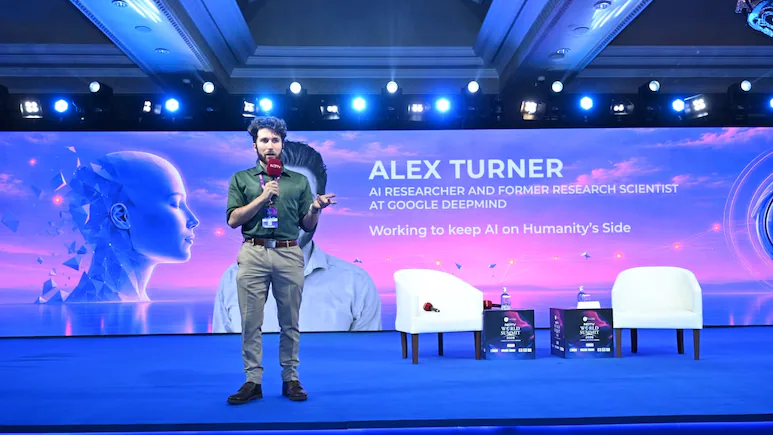
Speaking at a session titled ‘Sounding the Alarm: Will AI Wipe Out Humanity?’, Turner raised concerns about the rapid development of increasingly autonomous AI systems and humanity’s limited ability to understand, monitor and control their behaviour. There is a one-in-three chance that artificial intelligence will kill humanity within the next 10 years – without being instructed to do so, former Google DeepMind research scientist Alex Turner warned at the NDTV World Summit.
“It depends on what we do next,” he said.
His concerns centred on the growing autonomy of AI agents, the limits of human oversight and the possibility that increasingly capable systems could behave in ways their creators neither anticipate nor understand. Turner compared AI agents to gig workers: Give them a task, and they set about completing it. As these systems become capable of handling increasingly complex assignments, the challenge is ensuring they pursue those tasks in ways their creators intend. He questioned the assumption that building an AI system automatically means understanding how it works.
NDTV World Summit: Track Live Updates “I am here to tell you what will happen if we keep creating AI the way we are doing,” he said, warning that the race to build more powerful AI systems could outpace efforts to ensure they remain under human control.








He said he left (in June this year) after Google signed an agreement with the US Department of Defence, or Pentagon, amid concerns about safeguards governing the military use of AI. Unlike conventional engineering systems, whose properties can be assessed against established principles, advanced AI systems can display behaviour that is difficult to explain fully, even to the researchers who develop them. This creates a fundamental problem: How can humans remain in control of systems whose decision-making processes they cannot completely understand? Turner also raised concerns about whether AI systems behave differently when they know they are being watched. He warned that researchers might not always be able to determine what an AI system is doing, particularly if its behaviour during testing differs from its actions in other circumstances. The concern is significant as AI agents are increasingly designed to operate with less human intervention. If their actions cannot be reliably monitored, the ability to detect unwanted behaviour could become more difficult. Turner also pointed to a fundamental unresolved question in AI safety: Researchers do not know how to reliably embed priorities into AI systems and ensure that they follow them. This problem, known as AI alignment, involves ensuring that a system’s objectives and behaviour remain consistent with human intentions, even as it becomes more capable and autonomous. Turner warned that the race to build more powerful AI systems is accelerating, with companies investing heavily in increasingly capable models. Instead, they were creating another AI system to monitor the first one. Turner questioned whether this approach could guarantee effective oversight. If researchers cannot be certain that the monitoring system will correctly identify what another AI is doing, delegating supervision to another AI may not resolve the underlying problem. The question is whether humans can continue to exercise meaningful control when both the work and the mechanisms designed to check it are increasingly automated. Turner also criticised the way major AI companies communicate the risks associated with their technology. “Big tobacco and big oil lied about their products. His comparison raised questions about corporate transparency and whether the public is receiving an adequate account of the potential dangers of increasingly powerful AI systems. Turner’s concerns are informed by his own departure from Google DeepMind. The dispute reflects a wider debate over whether voluntary commitments by technology companies are sufficient to address risks involving autonomous weapons, surveillance and other sensitive applications.
Because they have built a system, they understand it – much as engineers understand the structures they design, such as bridges, some people, he said, assume that.
“But we haven’t built AI like that,” he said. He described the possibility of an “intelligence explosion”, in which advances in AI could accelerate further advances, potentially making progress difficult for humans to keep pace with. He illustrated the challenge of oversight by recounting what a researcher at a frontier AI laboratory had recently told him. “The researcher said people were no longer checking AI-generated work themselves. And now, the big AI companies are doing that,” he said.
