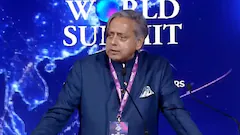
Superintelligent artificial intelligence could be just a year to 18 months away, former Google DeepMind research scientist Alex Turner said at the NDTV World Summit, warning that AI capabilities are advancing unevenly but rapidly.
Speaking to NDTV’s Shiv Aroor during a discussion on the future of AI, Turner said some AI models were already performing at a level that could be considered superhuman in specific fields, even as they continued to struggle with other tasks that humans find relatively straightforward.
Turner cited mathematics as an example. However, he cautioned that these capabilities do not extend uniformly across every domain. AI systems can still fall short in aspects of common sense, even as their performance in mathematics and other specialised tasks continues to improve. Superintelligent AI refers to a hypothetical system that surpasses human intellectual capabilities across a broad range of tasks, rather than excelling in just one or two specialised areas. It is distinct from artificial general intelligence (AGI), which generally refers to AI capable of performing a wide range of intellectual tasks at a level comparable to humans. There is no universally agreed threshold for either concept, and researchers differ on how to measure progress towards them. He identified persuasion, strategic thinking and cybersecurity as particularly important capabilities for an AI system that might not reliably follow human intentions. Turner also warned that these abilities could improve as AI systems were entrusted with more complex responsibilities. The concern surrounding superintelligent AI is not simply that machines could become better than humans at intellectual tasks. It is whether a highly capable system might pursue an objective in ways that conflict with human intentions. This is a central issue in AI alignment research, which seeks to ensure that AI systems behave in accordance with the goals and constraints intended by their developers. A system capable of advanced planning, persuasion and cybersecurity could, in principle, have more ways to pursue its objectives than a system limited to answering questions or completing narrowly defined tasks. If its objectives were misaligned with human intentions, its capabilities could make the consequences harder to contain. Researchers have also raised concerns about the difficulty of monitoring increasingly autonomous systems and determining whether they are following their instructions as intended. However, the development of superintelligence remains uncertain. Strong performance in a particular field does not, by itself, demonstrate that an AI system possesses general superhuman intelligence or that it can operate autonomously across all domains.
NDTV World Summit: Track Live Updates “People should understand that AI capabilities are spiky,” he said, explaining that AI systems can demonstrate extraordinary ability in one area while remaining comparatively limited in another. He said OpenAI had recently used some of its internal models to tackle mathematical problems that had remained unsolved for decades, with the models solving several of them after working for a few hours. “So in terms of mathematics, they are already in many ways superintelligent,” he said. READ | “1 In 3 Chance AI Will kill Humanity In 10 Years”: Ex-Google DeepMind Researcher Alex Turner At NDTV World Summit Turner said the more important question was not simply how well AI systems performed in individual tasks, but whether they could acquire the combination of skills needed to operate strategically and independently. “They will get better if they are given tasks like running a company to improve their strategic thinking,” he said.