After four hundred and ninety-one days, hope reached Kostiantyn Vlasenko in the form of a drone.
Asked what kept him going, he spoke of his daughter. “I haven’t talked to my daughter for a long time,” he said. “Maybe she’ll understand me, because dad was at war.”
‘Your Comrades Won’t Save You’ At one point, a Russian drone dropped a loudspeaker near him. Believe me, your comrades won’t save you,” it said. About six months passed between that idea and the flight, according to Oboronka, a Ukrainian media outlet that reported on the operation.
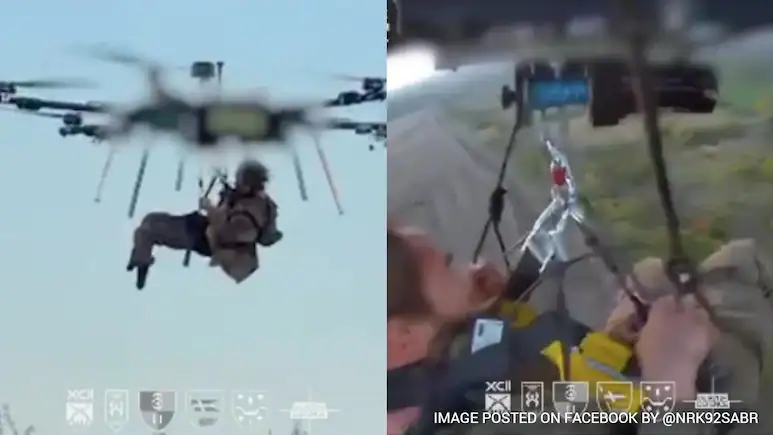
His comrade was dead. His left foot was gone in a Russian drone strike. The other one he had cut off himself, with a knife, on a brick. Above him, Russian drones watched every road, ditch and ruin. Rescue seemed impossible. By the account of the officer who planned the mission, trucks and armoured vehicles could not get through. Two ground robots sent to reach him were destroyed. Then, in early October, a supply parcel dropped by drone held something other than the usual food, cigarettes and occasional chocolates: a strange harness and a phone loaded with instruction videos. Vlasenko is from Kryvyi Rih and serves with the 30th Mechanised Brigade. By his account, the post was a concrete drainage pipe with a dug-out shelter beside it. Daily drone drops kept the two men supplied with food and other needs. On Vlasenko’s birthday, the drops reportedly included chocolate and premium cigarettes. Then the sky filled up with Russian drones. By his account, two relief soldiers were sent to his position, but they were killed on the way. Two more, sent to bring back their bodies, also died. The Flooded Foxhole And A New Shelter In mid-February, after months in the position, the foxhole flooded. The pair crawled into a wrecked school. A Russian surveillance drone soon spotted them as they went out to collect a parcel of dry clothes and food, and another drone attacked. Vlasenko’s left foot was hurt and rotted away months later, and his right leg was badly hurt in the fall. Barely able to move, he found a small space under the old boiler. By Vlasenko’s account, a recorded voice played from it. “Brother, we know you’re here. He stayed in that space under the boiler for months. He stayed in touch by radio. “It was very lonely. His wife sent a book by Stephen King, and he read it. He decided it had to come off. “Tears were flowing, I had to cut it. He used a tourniquet to stop the bleeding. He has kept his sense of humour. Six Months To Plan A Rescue The rescue began as an idea from the officer with the call sign Alex, who oversees drone work in the battalion. Officers heard about a heavy drone from a Ukrainian maker, Gurzuf Defence. It has six rotors and a black frame, and looks like a giant insect. The risk was that smaller Russian drones often shoot down large, slow ones. In early October, Vlasenko found a harness and a phone with instruction videos in his parcel. The pilot, call sign Black, had left notes in both Ukrainian and Russian. Three smaller drones flew alongside as decoys. For two hours, small attack drones, artillery and fixed-wing drones struck known Russian drone positions. Two ground teams waited along the route to service the batteries. Heights did not frighten him. “I can’t swim. The Ukrainian military calls it the first rescue of its kind. Vlasenko was taken to a military hospital in Kharkiv. He has had several operations and will need artificial limbs and rehabilitation. Asked what kept him going, he spoke of his daughter.
For almost eight of those months, the 49-year-old Ukrainian soldier had been alone in a hole about 80 by 60 centimetres wide, under the boiler of a wrecked school. The next day, on October 4, a giant six-propeller drone came down to him. Vlasenko clipped himself to the hook on its winch and rose about 70 metres into the air. Controlled remotely, the machine carried him about 15 km (9 miles) over the front line to safety. Basky was killed on February 16, his 50th birthday. He recalled telling his commander, “I don’t have flat feet and a size 44 now. They estimated Vlasenko weighed about 70 kg after more than a year at the front. Fifteen Kilometres In The Air On October 4, he was lifted.
“If you didn’t see it, it saw you,” he told a Ukrainian media outlet, Censor.net. He told Censor.net that he volunteered for the army. “They had so many of their mavics, their drones, that the sky was dirty,” he said. So he told his command not to send anyone else. “I’d rather die alone than have them die even more,” he said. “I was already on all fours, just crawling,” he said. Drones brought food, medicine, cigarettes and sweets every four to five days, according to the outlet Oboronka. “It was happiness for me that I wasn’t alone, that I could hear someone,” he said. They didn’t abandon me, my command didn’t abandon me,” he said. As his right leg got worse, Vlasenko told the Ukrainian outlet that the bone began pushing out through the skin, and the more he crawled for parcels, the worse it grew. “I put it on a brick, took a knife,” he said. “In April I lost my left foot, which rotted away on its own, and in May I cut off my right one myself,” he said. Units of the 30th, 14th and 43rd mechanised brigades and the 10th Army Corps took part, according to Oboronka. Vlasenko said one of his escort drones was shot down. “What I was afraid of was water,” he said, as the machine crossed the river. He waved an “okay” sign and made a heart shape for the drone’s camera. “I understood that there was a person below: I wanted to deliver him as quickly and as safely as possible,” Black, who remotely operated the drone, told Oboronka. “I haven’t talked to my daughter for a long time,” he said. “Maybe she’ll understand me, because dad was at war.”
Before the war, he drove giant trucks at a quarry. Last year, he was sent to a front-line position known as Vertun to join a comrade with the call sign Basky.