
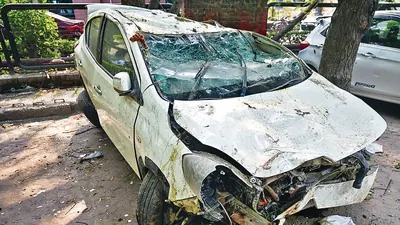
More than two years after the Bharatiya Nyaya Sanhita (BNS) replaced the Indian Penal Code, the provision meant to punish drivers who cause a death through rash driving and then flee remains on the books but out of force.
Recently, two high-profile crashes involving Sia, a motorcyclist hit on Gurugram ’s Golf Course Road in September, and three young people killed near Kerala ’s Nedumbassery in October by a speeding Mini Cooper drew markedly different criminal charges, exposing the hole the dormant clause leaves. “When a serious crash happens and gets in the media glare, there is understandable public pressure to invoke the strongest possible charge. But attempt to murder has specific legal ingredients, including the relevant intention or knowledge, and the prosecution has to prove them. The seriousness of the outcome, or even evidence of speeding, does not by itself settle that question. A charge has to fit the conduct and the evidence; otherwise, it may be difficult to sustain through prosecution and trial. “In a serious accident, every minute matters. Lawmakers tried to close this gap nearly five decades ago.
The Gurugram police added an attempt-to-murder charge after examining CCTV footage, while Kerala police registered a case of culpable homicide not amounting to murder in the absence of the BNS Section 106(2), . Section 106(2) prescribed up to 10 years in prison and a fine for causing death by rash and negligent driving and then escaping without reporting the incident to a police officer or magistrate soon after the crash. In January 2024, the government said it would consult the All India Motor Transport Congress before deciding whether to bring the clause into force after transport workers and forums raised concerns about the severity of the proposed punishment and the risk of mob violence at crash sites. But when the BNS took effect on July 1, 2024, Section 106(2) was left out of the commencement notification. When Section 106(2) is not in force, the specific offence of causing death through rash and negligent driving and then escaping without reporting cannot be invoked,” Singh said. A 1978 amendment bill to the Indian Penal Code proposed a new Section 304B to cover deaths, or injuries likely to cause death, caused by rash or negligent driving when the driver left without informing a police station within a reasonable time. It passed the Rajya Sabha but lapsed in 1979 when the Lok Sabha was dissolved.
Shubham Kumar, who leads policy advocacy at Crashfree India, said it was meant to address the additional culpability of leaving a fatal crash without reporting it, rather than treating every fatal collision as an intentional act. Amarjeet Singh, a Supreme Court advocate and director of PRAN (Plebeians Research and Academic Network) Foundation, said the provision aimed not only to increase punishment but also to encourage reporting and prompt medical assistance.
“Parliament has already legislated for this distinction. The government must now operationalise Section 106(2), while ensuring that its enforcement is accompanied by appropriate safeguards and clear procedures for drivers to report crashes and secure emergency assistance for victims.”
Similarly, Piyush Tewari, founder & CEO, SaveLIFE Foundation, said, “Such (murder) charges may appear stringent at the outset but can become difficult to sustain through investigation, prosecution and judicial scrutiny, ultimately weakening the prospects of conviction. He said the answer is not to stretch existing criminal provisions beyond their intended scope, but to ensure that the law appropriately recognises and penalises the conduct in question.
