
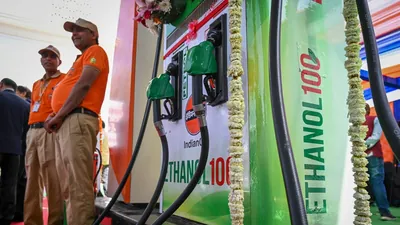
The Centre on Monday cleared a key regulatory hurdle for vehicles capable of running on 100% ethanol (E100), formally recognising this category alongside those fuelled by 85% ethanol (E85) in vehicle emission certification provisions.
The rules also specify that E85 or E100 can be used only in vehicles designed by original equipment manufacturers (OEMs) as flex-fuel vehicles. The changes do not make either fuel suitable for conventional petrol vehicles, including those designed for E10 or E20.
The Ministry of Road Transport and Highways (MoRTH) notified amendments to the Central Motor Vehicles Rules, 1989, on October 23, published in the Gazette on October 26, replacing references to E85 with “E85 or E100” in specified emission-related provisions.
The government has maintained that studies have found no significant adverse impact on vehicle performance or components from E20, while acknowledging that fuel economy can vary across vehicles. “Vehicles designed as Flex-fuel vehicles will not have material compatibility issues. The rollout has nevertheless prompted questions about the suitability of ethanol-blended fuel for older vehicles and its effect on mileage.
The roll-out of E20 petrol, which contains 20% ethanol, has seen motorists raise questions about fuel efficiency, compatibility with older vehicles and possible damage to engine components. It also linked the move to India’s long-term goal of achieving net-zero emissions by 2070. India achieved its target of blending 20% ethanol with petrol in 2025, ahead of the original 2030 deadline after the government advanced the target to 2025-26.
Motorists should check the fuel compatibility sticker on their vehicle and follow the manufacturer’s guidance in the owner’s manual while opting for the fuel choice at the fuel station,” MoRTH said in an explanatory note. The ministry said the adoption of flex-fuel technology could support domestic fuel production and energy security by reducing dependence on imported crude oil. The government has said that its assessment found no significant adverse impact on vehicle performance or components from E20.
His remarks were a forecast of possible launches, rather than confirmation that the companies had announced specific launch dates. To address industry concerns, the government has separately begun expanding the retail network for high-ethanol fuels. Ethanol industry bodies, too, welcomed the notification. But added that wider adoption would require coordination between vehicle manufacturers, fuel suppliers and ethanol producers.
In June, the petroleum ministry announced the launch of E85 at 48 public-sector oil marketing company outlets. It has planned to scale up the network to around 500 outlets by December 2026 and about 5,000 by December 2027.
At the HT Auto Leaderboard Awards and Summit 2026 on September 30, Union road transport and highways minister Nitin Gadkari said Mahindra, Toyota, Suzuki and Hyundai would “probably launch flex engines within one to two months”, capable of running on either petrol or 100% ethanol. CK Jain, president of the Grain Ethanol Manufacturers Association (GEMA), said the regulatory clearance was an encouraging development for India’s ethanol industry.
