
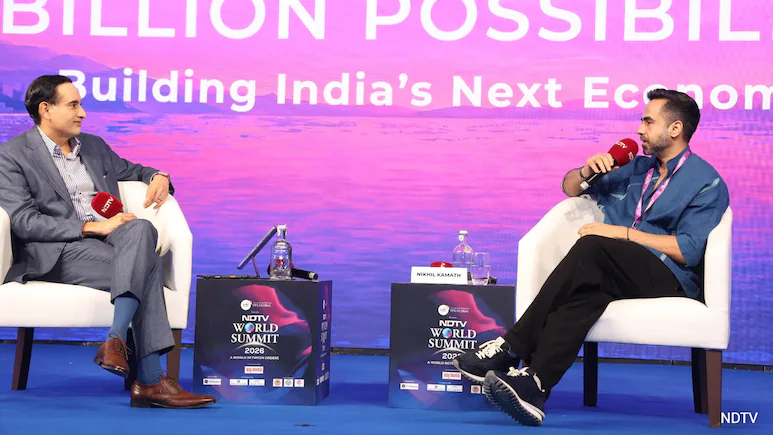
India may not need to compete with the US and China in every part of the artificial intelligence (AI) industry, but it could focus on areas where it has an advantage, such as building AI services at a lower cost, investor and entrepreneur Nikhil Kamath Nikhil Kamath said.
The brands being developed could operate in everyday product categories such as shampoo and toothpaste. Kamath also recalled a conversation with Microsoft CEO Satya Nadella at a previous summit. Nadella had pointed out that although he was Indian and lived in the US, he rarely used Indian products, whether in software, consumer goods or hardware.
Because it is the world’s largest consumer market, he added that the United States was a key target. Speaking at the NDTV World Summit 2026, Kamath explained why India may find it difficult to build advanced AI models like those being developed in the US and China.
He said these countries have access to much more risk capital, which allows companies to experiment and invest in new technologies.
The AI industry has several layers, from chips and computing power to advanced AI models, data providers and applications. “It would be really hard. I think the odds are low. However, he believes India has an opportunity to build AI companies that use open-source models to provide services to businesses. These companies could help businesses run AI systems more efficiently, reduce computing costs and keep their data private. It doesn’t share it with companies that develop advanced AI models. “Can India build a great inference company where we sit on top of open-source models? Kamath asked, pointing to one area where Indian companies could find an opportunity. Kamath also pointed out that electricity is significantly cheaper in India than in many parts of the world. These cost advantages could help Indian companies build and operate AI infrastructure more affordably. However, he cautioned against trying to build capabilities across every layer of the AI industry without considering whether enough risk capital is available to support such an effort. Kamath also spoke about China’s approach to business and economic growth, saying India could learn from the way different provinces compete with one another. “When I’m in China, it almost feels like the state is capitalist in itself. He explained that although China does not describe itself as a capitalist country, its local governments often compete with one another to attract investment and promote growth. “People are not allowed to own land but have long leases. It’s like owning land. The one thing that maybe we can change and learn from China,” Kamath added. Kamath also discussed the need for Indian businesses to build products for international markets instead of relying mainly on domestic consumption. “We are trying to build brands that can sell outside of India.
He further suggested that India’s 28 states could adopt a similar approach, with each state competing to attract businesses and encourage entrepreneurship.
Kamath said competing at the top level would be difficult for companies in countries that do not have access to similar amounts of capital. “I don’t see how an Indian company or any company outside of those two or three countries where there is that much risk capital having a fair shot at competing in that layer,” he said. “The cost of putting on a megawatt is probably 30-40% cheaper than it is in the West,” he said, referring to the cost of setting up the infrastructure required to run data centres. “Maybe we should learn from whoever has done something well,” he said. Every municipality or the mayor of each province competes with another province like he were a capitalistic organization,” he said. “Maybe the chief minister of a state could operate like the CEO of the state,” he said. Speaking about Foundery, which aims to support entrepreneurs in building consumer brands, he said the goal was to create businesses that could sell outside India. That’s the aspiration,” he said.
