
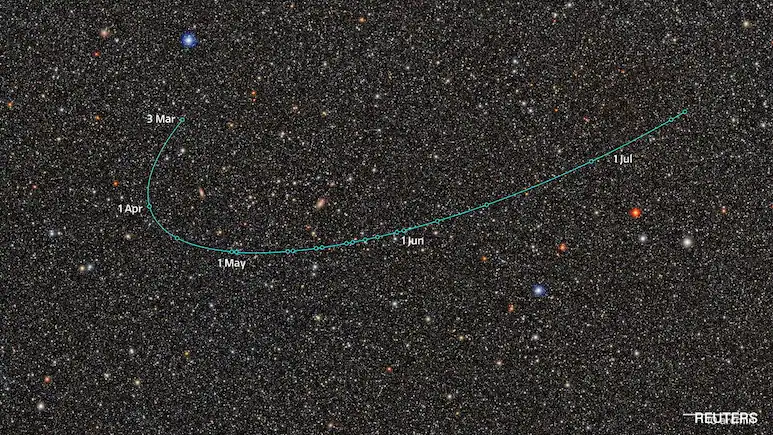
For generations, school children learnt that our solar system has nine planets. Nearly two decades later, the discovery of a distant icy world has brought the question of what makes a planet a planet back into focus. Then, in 2006, Pluto lost its place on that list and became a dwarf planet, a new category created by the International Astronomical Union (IAU). The object, provisionally known as 2026 ED138, has been discovered by the Vera C Rubin observatory in Chile, a country in South America.
The images revealed mountains, plains, glaciers and a thin atmosphere, showing that this distant, frozen world is far more complex than astronomers had once imagined. It is the strongest candidate for a dwarf planet. If further research confirms the object as a dwarf planet, it would join five officially recognized ones: Pluto, Ceris, Eris, Haumea and Makemake. The discovery is part of the humanity’s search for Planet Nine, a hypothetical planet in the outer reaches of the solar system that can fill the gap left by Pluto’s demotion. That status came under pressure as advances in telescopes allowed astronomers to detect more distant objects beyond Neptune. Scientists began finding icy worlds in a region known as the Kuiper Belt, where Pluto also resides. The finding raised a difficult question: If Pluto was a planet, should Eris and other similar objects also be considered planets? If every newly discovered world of a similar kind were added to the list, the number of planets could grow substantially. The IAU, the body responsible for the official classification of celestial objects, took up the question. Pluto did not meet all the criteria and was reclassified as a dwarf planet. The decision reduced the official number of planets in our Solar System from nine to eight. Under the IAU’s definition, a celestial body must meet three conditions to qualify as a planet in the solar system: It must orbit the Sun, have enough mass for its own gravity to make it nearly round, and have cleared the neighbourhood around its orbit of other objects of comparable size. Pluto meets the first two conditions but not the third. This does not mean its orbit is empty of every other object. Rather, a planet must be gravitationally dominant in its orbital neighbourhood, unlike Pluto, which shares the distant outer solar system with a population of other icy bodies. A dwarf planet, by contrast, orbits the Sun and is nearly round but has not cleared its orbital neighbourhood. It must also not be a satellite of another body. The distinction is based on the IAU’s classification system, not simply on whether an object is large, round or interesting. Instead, it adds to the growing body of evidence that the outer solar system contains many worlds that are difficult to detect from Earth. Pluto also has five known moons, including Charon, which is unusually large relative to Pluto itself. The spacecraft’s observations helped transform scientists’ understanding of Pluto and the distant region it inhabits. The new discovery offers another opportunity to explore that region. As telescopes become more powerful and surveys gather more data, astronomers may identify additional objects that help explain how the solar system formed and evolved.
Scientists estimate that it could be between 600 and 1,500 km wide and orbits the Sun at a distance roughly 46 times that between the Earth and the Sun. Pluto was discovered in 1930 by American astronomer Clyde Tombaugh and was long recognised as the solar system’s ninth planet. In 2005, astronomers announced the discovery of Eris, an object initially thought to be comparable in size to Pluto. In August 2006, its members approved a formal definition of a planet. The discovery of 2026 ED138 does not alter the official definition of a planet or change Pluto’s classification. NASA’s New Horizons spacecraft flew past Pluto in July 2015, providing the first close-up views of its surface.
“This is hopefully just the first of many finds,” Mario Juric, the lead solar system scientist for the Rubin Observatory, said at a press conference as reported by The New York Times .
