
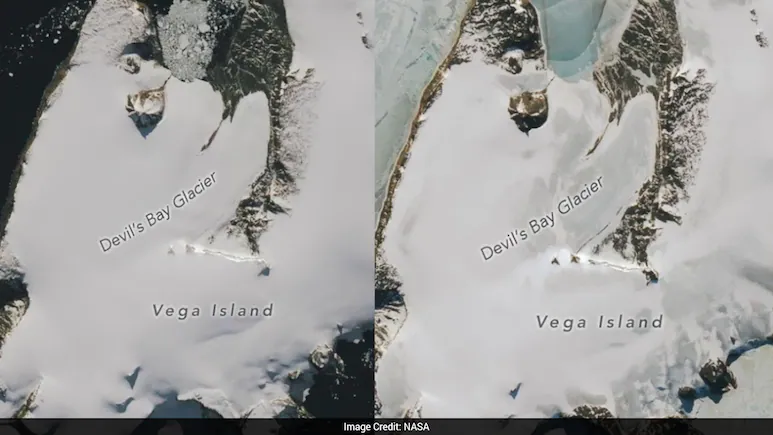
An island in Antarctica looks like a giant skull staring towards a nearby island, but its unusual shape is not the only thing that makes it stand out. Satellite images of Vega Island show that its ice-covered surface has changed over time, with large areas of dark ice now visible where snow once covered the land.
Warmer winter temperatures and a lack of fresh snow have contributed to this change, according to NASA .
Located east of the Antarctic Peninsula in the Weddell Sea, Vega Island has a landscape of ice, rocky outcrops and glacial deposits that together resemble a skull in profile. A rocky peak looks like an eye socket, a long ridge of glacial material forms a mouth, and the Bahia del Diablo, or Devil’s Bay, Glacier resembles a jawbone. The March image shows the island covered in snow, while the October image reveals large areas of darker ice without a snow cover. The exposed ice on Vega Island and nearby islands suggests that little new snow accumulated during the winter. The snow that did accumulate was further reduced by sublimation, a process in which ice or snow changes directly into water vapour, and by strong winds that remove snow from the surface. The lack of snow could also affect the island during the coming months. Dark ice absorbs more energy from the Sun than snow does. As the days become longer and warmer, the exposed ice could lead to faster melting. Pelto explained that even a thin layer of fresh snow from a spring storm could help slow the process in the short term. He also noted that the island’s skull-like appearance could change as the ice melts, with its jawline wearing away and its eye socket becoming larger. Satellite images taken over recent decades have also shown ice loss from other glaciers on Vega Island, along with an increase in the areas where the underlying bedrock is exposed.
Images captured by the Operational Land Imager (OLI) aboard Landsat 9 show what the island looked like on March 22, 2025, and October 10, 2026. Above-average winter temperatures in 2026, particularly in June, partly explain the large areas of exposed ice seen in October, according to glaciologist Mauri Pelto of Nichols College.
