
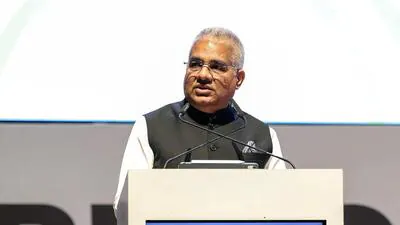
Union environment minister Bhupender Yadav on Tuesday outlined India’s priorities for the UN Climate Change Conference (COP31) in Antalya, Türkiye, from November 9 to 20.
He said India will approach the conference with a solution-oriented vision, bringing forth practical solutions for the Global South, with capacity building, knowledge sharing and geography-specific solutions at the core of discussions.
“We also believe that participation in carbon markets should be voluntary. On CBAM, we will stand by our position. When it comes to protecting India’s interests, that is what we speak about most strongly,” he added. India, as part of BRICS at the New Delhi declaration in September opposed unilateral, punitive, discriminatory and protectionist measures like CBAM, expressing concern that such measures undermine efforts by countries, specifically the developing countries.
Yadav further said India aims to work closely with G-77 and China, Like-Minded Developing Countries (LMDC) and BASIC countries.
Briefing the media, Yadav said predictable climate finance will be a key priority, alongside party-driven mitigation, technology transfer and discussions on the just transition. At COP31, Yadav said India is seeking a decision to commence the Climate Finance Work Programme – under which developed countries have to meet obligations to provide financial resources to developing nations for mitigation and adaptation. “Secondly, barriers relating to cost, intellectual property rights and trade must be removed because as long as we continue to create barriers to technology, smaller countries, particularly those that should benefit from such technology, will not receive those benefits,” he added, stating this is why India continues to oppose European Union’s carbon border adjustment mechanism (CBAM). “At COP31, we want to make positive contributions to global efforts with the goal of achieving the objectives of climate convention and the Paris Agreement,” he said, adding the country will also highlight the linkage between the need for adaptation in agriculture, food security and the livelihoods of small and marginal farmers. “We want to play a constructive, bridge-building role in Antalya, seeking an outcome that moves from commitments to implementation and support,” he said.
India will also press for mitigation and the Global Stocktake to remain party-driven, facilitative and non-punitive, respecting the nationally determined nature of NDCs [nationally determined contributions] and ruling out new top-down targets,” Yadav said on Tuesday. “There are IPCC [Intergovernmental Panel on Climate Change] reports from time to time, and interventions also come in. We say that science is informing us and telling us more and more about these challenges. Technology is assisting us, but access to it should be available to everyone in the world.
“Climate finance is an obligation of developed countries under Article 9.1 and must be predictable, largely public and concessional and should not add to the debt burden. The minister is expected to travel to Antalya on November 15.
The minister said climate adaptation too remains a priority for India, stating the agenda should remain separate from negotiations and that uniform global targets must respect national circumstances. On the prevailing impacts of El Nino, at a time when the West Asia crisis was still ongoing, Yadav said the impacts were for all countries to see. Nobody in the world can deny the challenges posed by climate change,” he said, stating India’s position on technology transfer was also clear – that it is an obligation of developed countries and must be shared with developing nations.
