
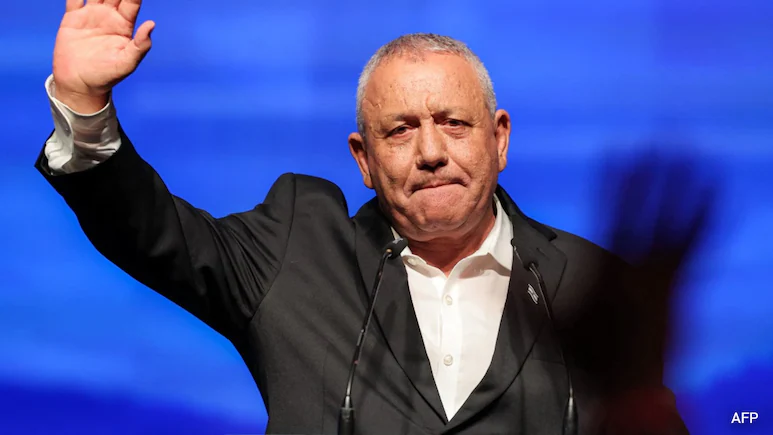
Israel’s opposition has rallied behind former military chief Gadi Eisenkot, leader of the Yashar party, as its prime ministerial candidate, a decisive move to end Benjamin Netanyahu’s long hold on power after an inconclusive election.
Leaders of the anti-Netanyahu bloc met in Herzliya and agreed to recommend Eisenkot to President Isaac Herzog as their first choice to form Israel’s 38th government. They also settled on a joint action plan for the newly elected 26th Knesset.
Avigdor Lieberman, whose Yisrael Beiteinu won seven seats, is among the most resistant. Leaders of the anti-Netanyahu bloc met in Herzliya and agreed to recommend Eisenkot to President Isaac Herzog as their first choice to form Israel’s 38th government. They also settled on a joint action plan for the newly elected 26th Knesset. It is the strongest sign yet that the opposition wants to turn its improved performance at the ballot box into a governing majority. Negotiating teams from the participating parties will start work immediately on a common policy platform and the broad outlines of a coalition. The leaders promised to stay in close contact until a new government takes oath. Their stated priority is speed. They want to form a government quickly and spare Israel yet another election, the latest in a long run of repeat polls. Bennett, Golan, Pile On Pressure Opposition leaders have been vocal on social media since the Herzliya meeting. The Arab Parties’ Question The hardest test for Eisenkot may be the role of Arab parties. In practice, politics is much harder than the arithmetic. That sets up a clear tension inside the camp. Eisenkot must find the votes he needs without splitting his own bloc. One possible route is a minority government that relies on outside support of Arab lawmakers, who would back it on key votes without formally joining the coalition. That could get a government off the ground, but it would remain vulnerable to political disputes and parliamentary challenges. Why Eisenkot A former chief of staff of the Israel Defence Forces, Eisenkot brings a security résumé that could help the opposition present itself as a credible alternative on national security, governance and accountability. The opposition has long blamed Netanyahu politically for the security failures that preceded the attack, and his government’s record was a central theme. The bloc is also ideologically wide-ranging, and backing one candidate is not the same as having a coalition. Parties must still agree on ministerial portfolios, policy priorities and security arrangements, and on how to secure the support needed to keep a government alive. Row Over Election Credibility The talks are unfolding amid a bitter dispute over the vote’s legitimacy. The opposition accuses Netanyahu and Likud of running a campaign to delegitimise the result and discredit the Central Elections Committee. Election authorities have rejected calls to overturn the outcome. He added that even proven allegations of foreign interference would not automatically invalidate the vote. The Shin Bet security agency is investigating the interference claims. He will nominate the lawmaker he considers best placed to form a government. The outcome is the gravest political challenge Netanyahu has faced in years. His allies lack majority, and the opposition is organising around an alternative. The coming weeks will show whether Israel is on the brink of a change of government or heading into another long deadlock. For now, the opposition agrees on one thing: it wants Netanyahu out. Whether it can agree on who and what should replace him remains the open question. They also decided to recommend Eisenkot to President Isaac Herzog for the first mandate to form the next government.
Because the Hamas attack of October 7, 2023, and the subsequent war in Gaza loomed over the campaign, that matters. Numbers Behind The Rush The October 27 vote produced a hung Knesset. Neither Netanyahu’s bloc nor the opposition reached the 61 seats needed for a majority in the 120-member house. Netanyahu’s Likud was the single largest party with 27 seats. But his allies together won only 53, a steep fall from the 68 his coalition held in the outgoing Knesset. Opposition parties with a Jewish majority won 48 seats. Arab-led parties won a record 19. Eisenkot’s Yashar won 21 seats, the most in the opposition’s Jewish-majority camp, which strengthens his claim to lead it. The Joint List won 11 seats and Ra’am won eight, giving them 19 seats and considerable leverage. On paper, adding those 19 seats to the opposition’s 48 gives a bloc of 67, comfortably above the 61-seat threshold. What Happens Next Herzog will receive the certified results on November 4 and then begin consultations with representatives of the parties elected to the 26th Knesset. That nominee has 28 days to build a coalition, with a possible 14-day extension. The new Knesset will be sworn in on November 10. Earlier reporting noted: Israel opposition backs Gadi Eisenkot for PM, vows to replace Netanyahu’s ‘October 7 government’ Israel’s opposition parties have agreed to rally behind Yashar party leader Gadi Eisenkot as their candidate for prime minister, setting in motion efforts to form the next government and end Benjamin Netanyahu’s tenure. In their joint statement, the leaders described Netanyahu’s administration as the ‘7/10 government’ and said they would work together to establish a new government at the earliest.
“A Zionist Government” Built On Four Principles In a joint statement, the party heads said they would work to replace what they called the “7/10 government” with a “national emergency government”. They said it would be a “Zionist” government based on four principles set out by Eisenkot. The leaders pledged “full commitment” to the decision of Israeli voters, whom they described as having voted “clearly and decisively” for change. Yair Golan said he had just come out of a meeting with the heads of the “Change bloc”. He described the mood as positive but said the work was “still far from complete”. He insisted that the majority “is in our hands” and urged the public to keep demanding that elected officials act on the voters’ will. Former prime minister Naftali Bennett, whose “Together” party is part of the camp, stressed urgency. He said there was no time to lose and that his entire party would back Eisenkot “with all its might” to form a government as soon as possible. On X, Lieberman said Israel must prevent additional elections. He argued that the new political situation leaves “sufficient room for manoeuvre” to set up a stable government “without Ra’am and the Joint List”. The joint statement called it a “dangerous and outrageous delegitimisation campaign” and vowed to protect the results. Committee chairman Justice Noam Sohlberg said the election was properly held and reflects the voters’ choice.
Several Opposition leaders have previously ruled out sitting in a coalition with Arab parties. Earlier reporting noted: The leaders of the Change bloc reached the agreement during a meeting in Herzliya, where they discussed using their majority in the newly elected 26th Knesset to establish the country’s 38th government. Earlier reporting noted: The opposition alliance aims to secure an early transfer of power and prevent Israel from heading into another election.
