
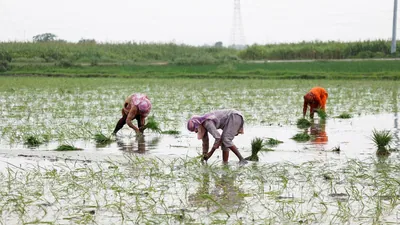
Climate change is reducing crop yields, disrupting food supply chains, and pushing up food prices in India, with economic losses extending beyond farms to retailers and consumers, according to a new white paper by the research-based consulting initiative Climate Trends launched in New Delhi on Wednesday.
These pressures are affecting agricultural production, food availability and affordability, while threatening rural livelihoods, it adds. The paper consolidates existing evidence on climate and ecological risks facing Indian agriculture and recommends pathways towards an agroecological transition. The impact of climate change is already evident in India’s crop yields, with projections indicating further losses. Climate shocks are also contributing to food inflation. The shortfall prompted the government to restrict wheat exports to protect domestic supplies.
Research cited in the paper estimates that a 1°C rise in temperature over the past five decades has reduced average yields across crops nationally by about 8%. The impact is greater for climate-sensitive crops such as maize, where yield losses have reached up to 16%. A 20% decline in rainfall could reduce paddy yields by 12%, the research found. Wheat production in India could fall by as much as 23% by 2050 under climate change scenarios. The paper also cites projections of a 10-17% decline in fish catches by 2050. The report cites a Reserve Bank of India study which found that a one-unit increase in temperature deviation raised vegetable inflation by around 1.3 percentage points during April 2014-March 2024. In 2024, extreme heatwaves affected onion production, pushing prices up by 80%. The paper also points to the impact of heat stress on wheat production in 2022, when output declined from 109.59 million tonnes in 2020-21 to 106.83 million tonnes in 2021-22.
Ecology and the Future of Indian Agriculture’, India’s food systems are facing the combined impact of rising temperatures, erratic rainfall, extreme weather events and ecological degradation, according to the report titled ‘From Risk to Resilience: Climate Change.
