
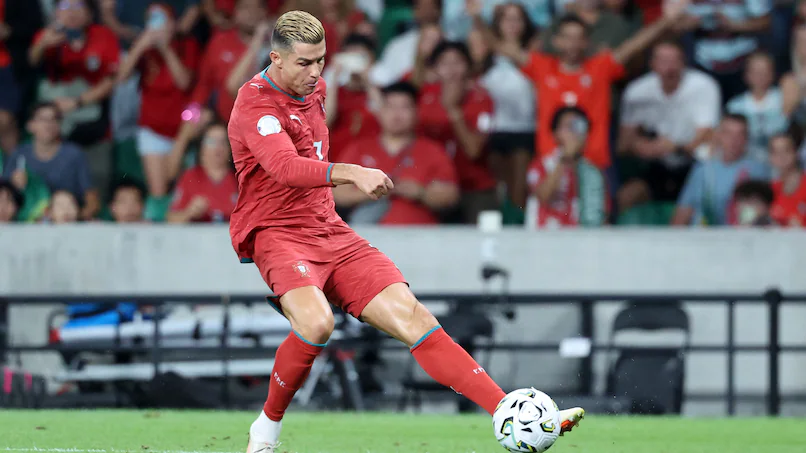
Cristiano Ronaldo’s international career has come to an end after 23 years, with the Portugal captain announcing his retirement from national team football on Thursday, bringing the curtain down on a remarkable journey in which he established himself as the men’s game’s most prolific international goalscorer and most-capped player. The 41-year-old Al-Nassr forward leaves international football with 146 goals in 234 appearances for Portugal, both all-time records in men’s international football. His career with the national team began on August 20, 2003, when he made his debut as a substitute against Kazakhstan, and concluded on September 24, 2026.
Cristiano Ronaldo’s international career has come to an end after 23 years, with the Portugal captain announcing his retirement from national team football on Thursday.
Today, the time has come to pass it on to the future,” Ronaldo said in an Instagram post. I never felt it belonged to me alone. His retirement marks the end of one of the most statistically extraordinary international careers in football history. From his first appearance as a teenager to becoming Portugal’s captain and leading the country to major international honours, Ronaldo’s contribution extended across six European Championships and six FIFA World Cup editions.
“To the Portuguese people, the day has come for me to hand back the number 7 shirt of our National Team. But for 23 years, I had the privilege and the responsibility of wearing it, defending it, and carrying it with me into stadiums all around the world. He is also the first player to score in six different editions of the FIFA World Cup, having found the net at the 2006, 2010, 2014, 2018, 2022 and 2026 tournaments. The Portuguese forward scored 11 goals in 27 World Cup appearances, making him his country’s leading goalscorer in the competition. His 14 goals in European Championship final tournaments are also a men’s record. Ronaldo has scored against 49 different national-team opponents, underlining his consistency across a wide range of international competitions and qualifying campaigns. Luxembourg have been his most frequent victims, conceding 11 goals to him, followed by Hungary with nine.
