
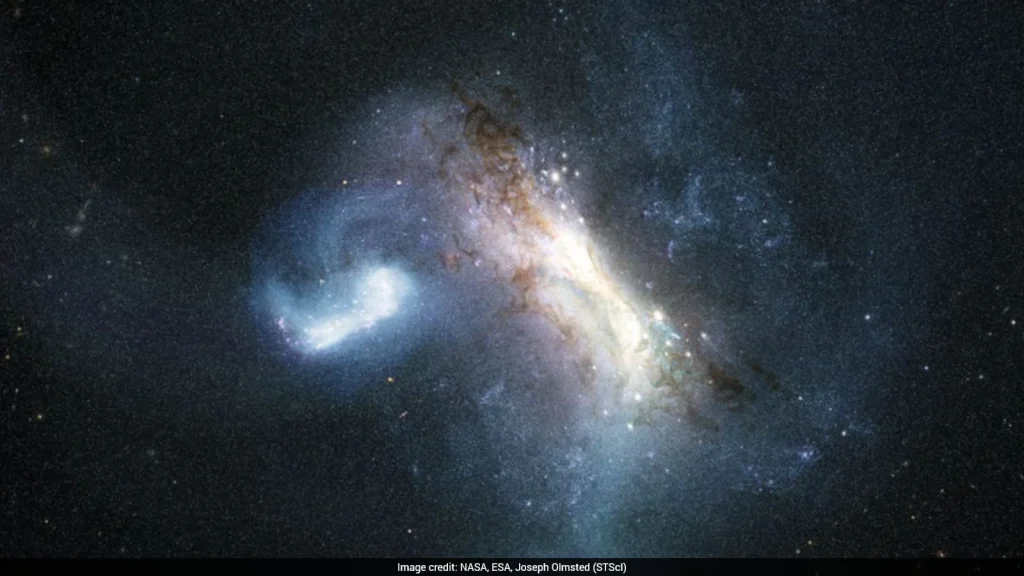
Astronomers using NASA’s Hubble Space Telescope have unlocked a long-standing cosmic mystery, revealing definitive evidence of a massive galactic collision that took place nearly 12 billion years ago. The discovery pushes scientists’ understanding of the Milky Way’s growth 1.8 billion years further back into the past than previously documented, according to NASA.
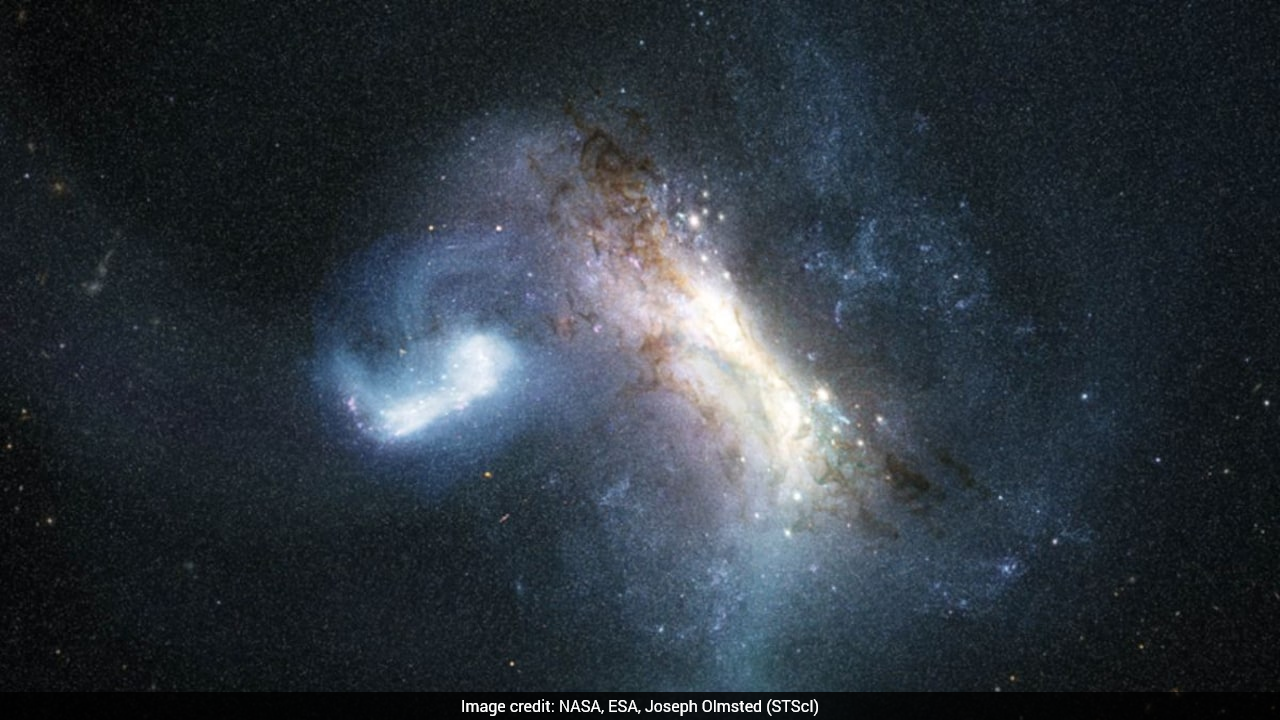
Scientists also used astronomical surveys and precision data from spacecraft like Gaia mission to piece together the history of our galaxy.
As we know, our home galaxy today is a massive spiral galaxy with hundreds of billions of stars. But it wasn’t always like that. Scientists have noted that the galaxy was once smaller, and it eventually grew by forming new stars from its gas clouds as well as collecting stars, gas, and dark matter from other galaxies through mergers. Scientists used astronomical surveys and precision data from spacecraft like European Space Agency’s Gaia mission to piece together the history of our galaxy.
Because the young Milky Way was much smaller back then, this merger contributed a major fraction of the stars, gas, and dark matter that formed our galaxy’s foundation. They analyzed 39 ancient globular clusters, located within 20,000 light-years of the Milky Way’s core. At the time of impact, LKH had a stellar mass equal to roughly 500 million Suns.
“Thanks to the high resolution and depth of Hubble imaging, we could measure the age and the metal content of these clusters with unprecedented precision,” Chiara Zerbinati, study co-author, University of Bologna in Italy, said in the statement. By examining the exact ages and heavy element content (“metallicity”) of these clusters, scientists identified three separate groups, clusters native to the early Milky Way, clusters absorbed during a well-known merger with the Gaia-Sausage-Enceladus galaxy 10 billion years ago, a newly confirmed, distinct set of clusters born in LKH before it was consumed 11.8 billion years ago.
