
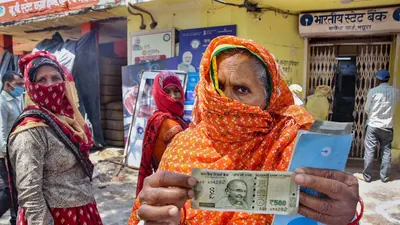
As of August 12, 2026, nearly 590 million people are enrolled in the Pradhan Mantri Jan Dhan Yojana, a scheme launched in 2014 to improve banking access in India. Notably, over 56% of these enrollees are women, marking a significant shift in financial inclusion. In 2014, the gender gap in bank account ownership was 20 percentage points, but by 2023, 89% of women in the poorest 20% of the population had bank accounts, compared to 94% of men, according to a February 2025 report from Data for India.
Despite this progress, a new challenge has emerged. The current issue is not just access to banking services, but whether women have true agency over the funds in their accounts.
Having an account and actually using it are two very different things.India has had remarkable success in addressing the first problem, but the second remains a work in progress. The gap is even more stark when you look at inactive accounts. One reason financial inclusion is critical is that it provides loans to finance personal and professional needs. The first is economic. So, many women do not have independent income to begin with. Since banks often require collateral for anything beyond a small loan, the lack of property ownership helps explain why women’s loans tend to remain small. The second barrier is about agency, not money, and is harder to fix. All of this suggests that financial inclusion in India has reached the point where policy has already picked the low-hanging fruit and further advances require something beyond it. Opening accounts and giving out small loans solve a logistical problem, and India has solved it well. What remains is a deeper problem: whether women, once they have access to the financial system, can leverage it to achieve upward mobility for themselves, their firms, or their households. That is not something a bank account can fix on its own, since it comes from inside the household, not from the banking system. Closing that gap requires a change in social norms and a shift in social beliefs, not just getting more access. True financial inclusion should ultimately be measured by women’s ability to exercise economic agency, not just by how many accounts exist in their names.
India has the largest gender gap in account inactivity of any country in the world, at 12 percentage points, and around a third of women’s accounts are inactive. A NITI Aayog report in April 2026 said women account for almost 26% of formal credit. Only 32% of married women are employed, and of those, 15 % are not paid at all for their work. On top of that, only 42% of women own a house and 32% own land, compared with 60% and 42% of men.
Across the country, one in three bank accounts belongs to a woman, but women only hold about a fifth of the total money deposited in banks, according to an Observer Research Foundation paper. While the trend shows improvement—the report notes that “women borrowers are progressively moving beyond entry-level credit towards retail and business-purpose lending”—there is still much to be achieved.
