
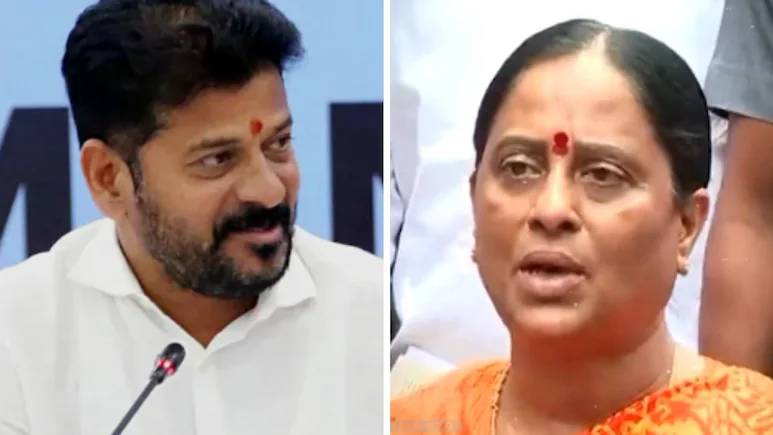
In a significant development within the Telangana Congress, Chief Minister Revanth Reddy has dismissed Endowments Minister Konda Surekha from his cabinet. This decision marks a pivotal moment in the ongoing conflict between the party’s old guard and new guard factions. The internal struggle has intensified, highlighting the deep divisions within the party as it navigates leadership challenges.
These appointments are seen within Congress circles as efforts to limit the political fallout of Surekha’s removal and reassure OBC leaders that the action against one prominent leader won’t lead to wider marginalisation. The episode has revealed an increasing divide between the party’s established leadership and the newer generation that has mushroomed around Revanth Reddy since the Congress’s return to power in Telangana. Revanth Reddy’s move came after the Telangana Pradesh Congress Committee’s disciplinary committee recommended action against the minister over controversial remarks made by her daughter, Konda Sushmita Patel, against the chief minister and his family. The disciplinary committee reportedly proposed not only Surekha’s removal from the cabinet but also the removal of Chinna Reddy from the Telangana Planning Board, citing violations of party discipline. The decision to act against Surekha signifies a substantial escalation in the ongoing confrontation between the chief minister and certain sections of the Congress leadership, who have become increasingly critical of how the Telangana unit is being managed. The controversy erupted after Surekha’s daughter, Sushmita Patel, made remarks against Revanth Reddy and his family during a public programme in August. Surekha maintained that her daughter’s views were personal and that she should not be held responsible for them. However, that explanation failed to satisfy parts of the state Congress, especially MLAs perceived as close to the chief minister, who demanded disciplinary action against the minister. Revanth is understood to have discussed the issue with Congress President Mallikarjun Kharge and AICC general secretary (organisation) K.C. Venugopal during his visit to Delhi, urging stringent measures. Meanwhile, Surekha refused to resign despite mounting pressure and challenged the party leadership to take action against her. She also wrote letters to the AICC top brass, expressing her discontent at her removal. “I was dismissed without any prior notice. The letter was issued without my signature. I have not made any decisions yet. I have been trying for ten years to secure a party ticket for my daughter. I have not committed any corruption. Recognising the political optics, Revanth Reddy has moved swiftly to bolster OBC representation in the same region. As part of this balancing act, three OBC women from Warangal district have been appointed to key boards and corporations: Gadwal Vijayalakshmi as vice-chairperson of the Telangana Planning Board, Nerella Sharada as chairperson of the Telangana State Women’s Commission, and former Rajya Sabha MP G. Sudha Rani as chairperson of the Kakatiya Urban Development Authority. What started as a controversy over comments by a minister’s daughter has escalated into a broader conflict over who controls the Telangana Congress. The so-called old guard includes senior leaders such as Deputy Chief Minister Mallu Bhatti Vikramarka, Ministers N. Uttam Kumar Reddy, Komatireddy Venkat Reddy, D. Sridhar Babu, Damodar Rajanarasimha, Konda Surekha, and veteran leader V. Hanumantha Rao. On the other side is the Revanth Reddy-led faction, comprising leaders and MPs aligned with the Chief Minister’s expanding political network, including Chamala Kiran Kumar Reddy, Anil Kumar Yadav, Vem Narender Reddy, and ministers like Ponguleti Srinivasa Reddy and Seethakka. The increasing friction suggests that the conflict is no longer simply about individual statements or disciplinary breaches, but about political influence and succession within the Telangana Congress. The Surekha controversy comes amid rising tensions between senior Congress veterans and the new leadership. Nalgonda’s prominent leader, Komatireddy Rajagopal Reddy, recently issued a warning against attempts by newcomers to dominate the state Congress.
What do what my family members said have to do with me? At the very least, they should have spoken to me before making such a decision,” said Konda Surekha.
His remarks add to the perception that Telangana Congress is witnessing a deeper rivalry between longstanding leaders and those consolidating around Revanth Reddy. As the chief minister has succeeded in dismissing Surekha without major backlash, he has solidified his authority over the cabinet and the party organisation. It also signals to dissenting leaders that defying the chief minister openly has consequences. For now, the political message from Hyderabad is clear: the Konda Surekha case goes beyond a disciplinary issue. Her removal from the cabinet marks a key moment in the ongoing power struggle over the future direction of the Telangana Congress.
“If they come to our home and drive us out, it’s not good,” he said, asserting that nobody could “capture” the Congress while he remains in the party.
Political Implications of Surekha’s Cabinet Removal
The chief minister’s decision to recommend Surekha’s removal from the cabinet underscores his authority and sends a clear message to other leaders within the state unit about his control over ministerial appointments. This dismissal is not just about Surekha; it carries broader political implications.
Surekha, a woman leader with a significant following in the former Warangal region, could face backlash from certain Other Backward Classes (OBC) groups due to her removal. Critics may seize this opportunity to accuse the Congress party of favoritism towards leaders from specific social and political backgrounds. Furthermore, Surekha has raised concerns about the perceived disparity in treatment between leaders from Backward Classes and those from non-Backward Classes, questioning the party’s standards in these matters.
