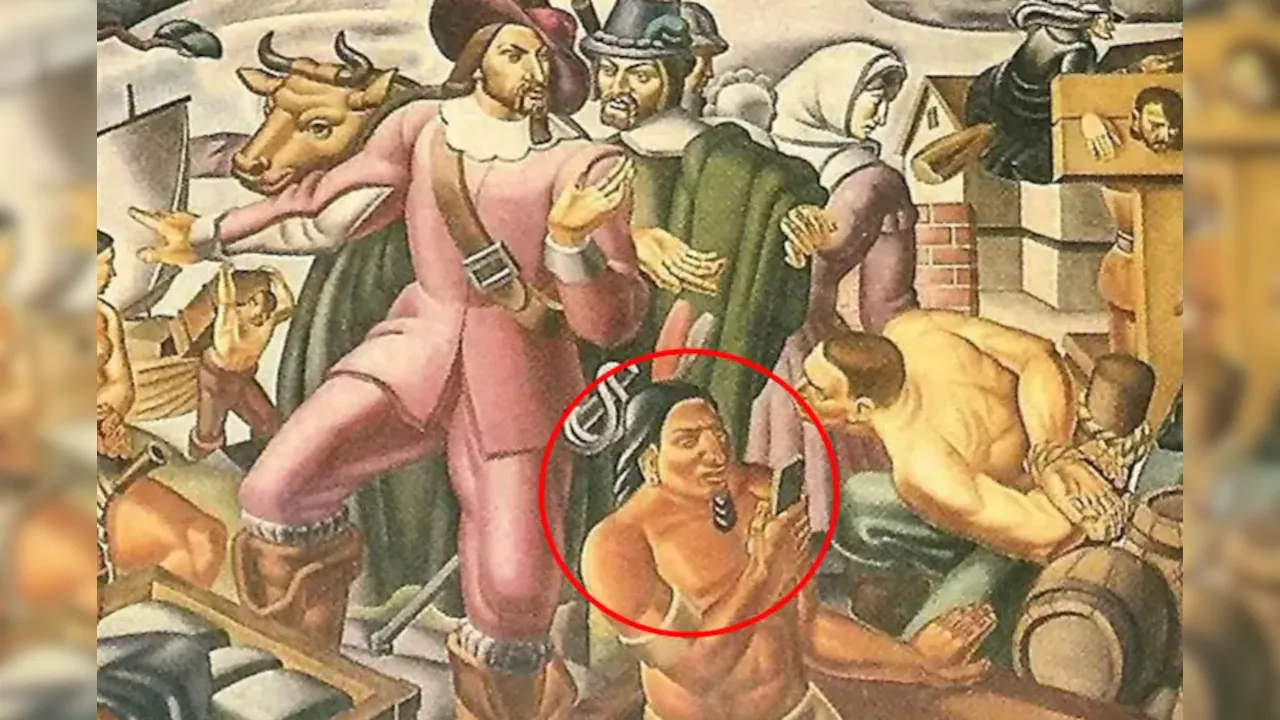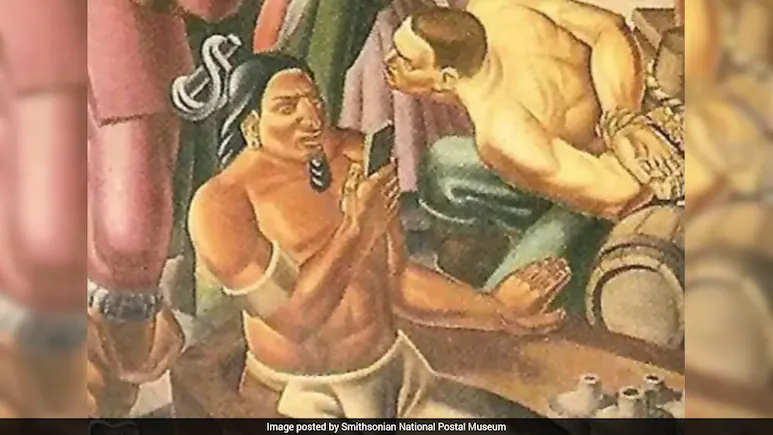
The artwork depicts an encounter between Indigenous people and English settlers in 17th-century Massachusetts, as per Vice . At the centre of the scene, one Indigenous man appears to be looking closely at a dark, rectangular object held in his hands. A nearly 90-year-old painting has become the centre of an unusual internet debate after social media users spotted a man holding a small rectangular object that looks quite similar to a modern smartphone. The 1937 mural, titled ‘Mr Pynchon and the Settling of Springfield’, was painted by Italian-American artist Umberto Romano.
See the image here: Photo Credit: Smithsonian National Postal Museum The object appears dark, with reflective edges, and the man’s posture makes it look as though he is examining a handheld device in much the same way people look at their phones today. From today’s perspective, the way he appears to be looking at the object can easily create the illusion that he is checking a smartphone. Some have jokingly suggested that the painting could be evidence of time travel, while others have seriously questioned how something resembling a modern electronic device could appear in a scene set centuries before smartphones existed. There’s a man using an iPhone. There’s also another guy tied up,like they’re goin thru his phone or somethin. Could it be a phone or something simpler? However, there is no evidence that Romano intended to depict a smartphone or anything resembling modern technology. The more likely explanation is considerably less mysterious, as the object is believed to be a mirror. Mirrors were among the European goods traded with Indigenous communities during the colonial period, making a small hand mirror a plausible object for the man to be holding, as per New York Post. Other interpretations have also surfaced online, with some viewers suggesting that the object could be a small book, a religious text or even a weapon. But the mirror explanation fits the historical setting far better than the time-travel theory. The project was supported by the Federal Art Project, a US government programme that employed artists during the Great Depression. The painting centres on William Pynchon, one of the founders of present-day Springfield. Romano reportedly consulted local historian Harry Andrews Wright and author Esther Forbes while developing the murals. His broader aim was to portray the history and development of the region from the 17th century through the early 20th century.
Because of its resemblance to a smartphone, the object has caught the attention of social media users. This picture depicts the founding of Springfield Massachusetts in 1636. Romano completed it in 1937 as one of six murals created for the Springfield Main Post Office, which is now the Commonwealth of Massachusetts State Office Building. Pynchon established a trading post in the area after acquiring land from the Agawam people in 1636.
“Phone in painting from 1937 JUST DISCOVERED???” wrote one user. Another said, “Spot anything weird? Romano created the mural with students and based it loosely on events involving English settlers and members of the Pocumtuc and Nipmuc tribes in the Agawam area of present-day Massachusetts during the 1630s, according to the Smithsonian National Postal Museum .