
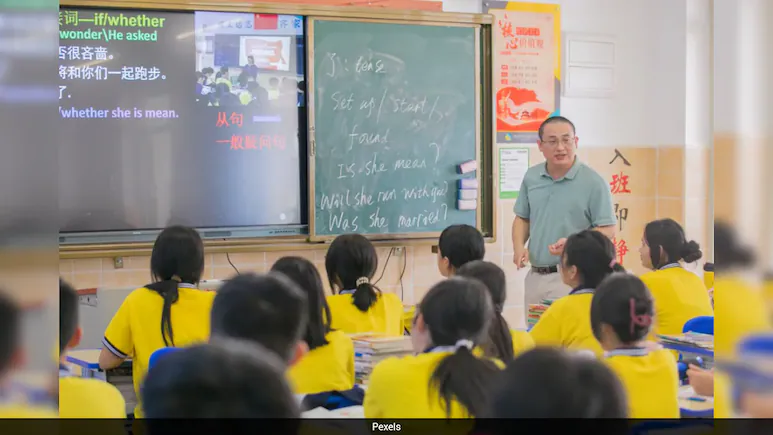
The discussion was reignited by Tang Jiafeng, a Chinese mathematics teacher and online influencer who argues that English should no longer be treated as a core subject in elementary schools, secondary schools and universities, the South China Morning Post reported. English is one of the world’s most widely spoken languages, but in China, a growing debate is questioning how much importance the language should have in the education system.
“I publicly call for English to be stripped of its status as a core subject. No country in the world places English in such a supreme position as we do,” he wrote on social media.
Tang, who is known for coaching students preparing for China’s national postgraduate entrance exam, said Chinese students, parents and schools spend too much time and money learning English. “How many resources and how much time do our children, parents and schools invest in a subject that is completely irrelevant to the majority of people in their future professional lives?” the mathematician asked.
Concerns Over English’s Role in Chinese Education System
Concerns are rising regarding the emphasis on English in China’s education system. Tang, an educator, argues that children are often required to learn English before they have fully mastered their native language. He believes this approach is misguided, stating, “Our children desperately begin learning English even before they have properly mastered their native language. Yet we are a civilization that dates back thousands of years. English is just a tool. It’s enough to be able to use it. The tradition of revering and emulating Western cultures must come to an end.”
Tang’s comments coincide with recent changes in local examinations that have diminished the weight of history in the curriculum. He criticizes this shift, asserting that history plays a crucial role in helping students understand past hardships and develop core values. He advocates for reducing the focus on English instead, emphasizing that it should not overshadow other vital subjects.
Currently, English is a core subject in China’s basic education system, introduced in the third grade alongside Chinese and mathematics. Each subject holds equal weight in the gaokao, China’s national college entrance exam, where Chinese, mathematics, and English each contribute 150 points to the traditional 750-point total. The intense focus on English has given rise to a robust private tutoring industry, with many parents investing in extra classes aimed at examination success.
Tang warns that this pressure can create barriers for students, particularly those excelling in science and mathematics who may struggle with English despite their potential in their chosen fields.
Hu Xijin, the former editor-in-chief of the state-run Global Times , criticised calls to remove English as a core subject. He argued that dismissing English as an unnecessary foreign influence was overly “nationalistic and narrow-minded. “The present is shaped by globalisation. China’s opening up is not only state policy but also expands people’s scope of action as well as the range of their diverse material and immaterial interests in life,” Hu stated, as per DW.com. Supporters of keeping English compulsory point out that the language remains particularly important in science, technology and academia. Much of the latest research in STEM fields is published in English, giving students with strong language skills easier access to international research, universities and professional networks. Hu further argued that English gives students access to knowledge and opportunities beyond China. He also warned that reducing English in public schools could increase inequality. Wealthier families would still be able to pay for private English education, while students from less privileged backgrounds could lose access to the same opportunities. “Basic education should leave everyone room to advance as far as they possibly can. This is not about ‘worshipping foreign things’; it is about educational equality at the starting point of real life,” he added.
