
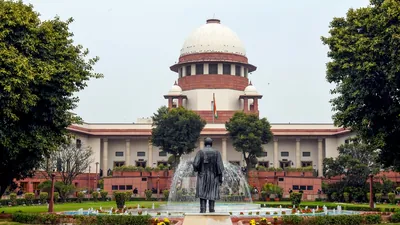
The Supreme Court on Monday reportedly directed the Uttar Pradesh government to pay ₹ 6 lakh in compensation to a man who spent nearly six years in jail as an undertrial in a kidnapping and murder case before being acquitted.
The top court criticised the police investigation and prosecution, calling the case a “travesty of justice”, as per LiveLaw.
The court also asked the Uttar Pradesh Police to train officers in proper investigation methods, warning that a poor investigation could put a person’s life and freedom at risk. The petitioner was not named in the FIR or in the complainant’s statement to the police, as per LiveLaw. Investigators later linked him to the crime using CCTV footage and an alleged confession by a co-accused. The co-accused died during the trial, while another accused, his mother, remained absconding. The petitioner was the only accused who faced trial. The court also pointed out that a sub-inspector had not testified that the complainant identified the accused in the CCTV footage or recognised him as one of the people who had approached him on the day of the incident.
Because of a false story based on assumptions rather than proper evidence, a bench of Justice JB Pardiwala and Justice K Vinod Chandran said the man lost six years of his life. Because of faulty investigations, they must also ensure that innocent people do not suffer. The case began with an FIR registered in Agra district in October 2019 in connection with a kidnapping and murder. Police arrested the man on November 14, 2019.
“Not even a rudimentary investigation was carried out,” the bench observed. The Supreme Court said police and prosecutors must not focus only on securing convictions. The court said it examined the trial court’s judgment to highlight the failures in the investigation and urged the Uttar Pradesh government to train police officers in proper investigation procedures to prevent similar cases in the future.
In March, the Supreme Court directed the trial court to complete the trial within three months while hearing his bail plea. The bench noted that he spent a long time in jail and that the case relied entirely on circumstantial evidence.
