
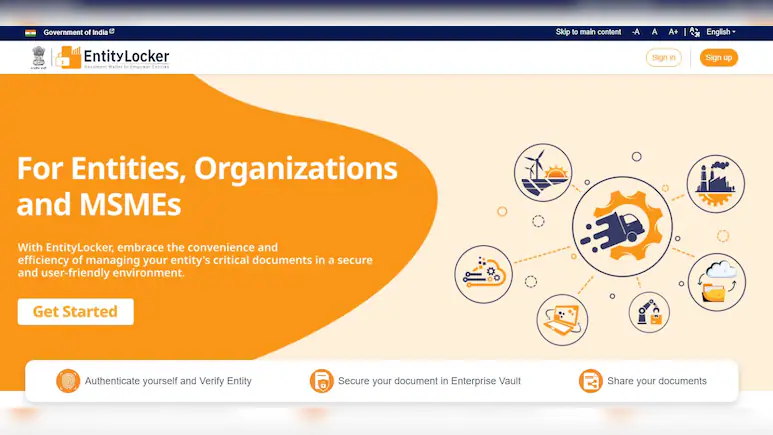
The government is exploring the international expansion of its digital wallet architecture for businesses. Discussions are currently underway for the integration of Entity Locker with potential partners in Russia, the European Union, and Singapore, according to NDTV.
“The proposal — modelled on India’s efforts to integrate DigiLocker with other countries — is happening on a diplomatic level. The plan represents the next leg of the government’s push to make India’s digital public infrastructure interoperable across borders. India will host the 18th BRICS Summit at Bharat Mandapam in New Delhi on September 12-13, bringing together leaders of member and partner countries.
Also, banks from Russia, European Union and Singapore are involved in the talks,” an official familiar with the matter said. The government has not publicly listed Entity Locker as part of the summit agenda, and discussions on the platform remain at a diplomatic preliminary stage, officials said.
DigiLocker Showed The Way DigiLocker, launched under the Digital India programme, is the government’s flagship platform for issuing and verifying documents and certificates electronically. How Document Sharing Will Work Under the model being explored, businesses could securely share authenticated documents with authorised entities in another country instead of repeatedly submitting physical or scanned copies. The documents could include bank records, bank guarantees, FSSAI certificates and other regulatory and corporate credentials. “The change has to happen in a safe and encrypted manner. India has increasingly sought to export this architecture as part of its wider push to take India Stack overseas. MeitY has held consultations and technical workshops with partner countries to identify digital solutions that can be deployed locally. Kenya, for instance, has concluded an implementation framework agreement and non-disclosure agreement with India for DigiLocker, while development of a foundational DigiLocker solution in Cuba has started. It gives users a secure cloud-based account, through which they can fetch, store and share authentic documents issued by government departments and other registered issuers, reducing dependence on physical copies. It is now used for documents ranging from driving licences and PAN to academic certificates and government-issued credentials. The architecture is also beginning to facilitate cross-border verification without necessarily requiring another country to replicate the entire platform. In August, NeGD partnered with the Association of Australian Education Representatives in India to launch AAERI Verify, which is integrated with DigiLocker and enables consent-based verification of Indian students’ academic, identity and financial records for applications to Australian universities. It is this model of source-verified and consent-based document exchange that the government now wants to extend to businesses through the Entity Locker. Roadmap For Entity Locker Entity Locker, developed by the National e-Governance Division under MeitY, is a secure cloud-based platform for organisations including companies, MSMEs, startups, trusts, societies and government entities. It allows them to obtain, store, share and verify business documents digitally. A high-level committee formed in February has been tasked with — among other things — creating a future roadmap for Entity Locker, expanding its ecosystem and examining commercialisation of the broader Digital Locker system. Cross-border interoperability could substantially expand that role. Entity Locker has already begun integrating financial documents domestically. Its integration with National E-Governance Services Ltd’s digital-document platform allows businesses to fetch digitally executed electronic bank guarantees directly into their Entity Locker accounts. For industry, international integration could reduce one of the persistent frictions in cross-border business, that is, repeatedly establishing the authenticity of the same documents. “An Indian exporter, for example, may need to provide licences, food-safety certifications, banking records and corporate credentials to overseas buyers, banks or authorities. That could be particularly useful for exporters and MSMEs, where the cost and time involved in document verification can become a significant compliance burden. India, he added, has already shown that its digital systems can work at scale and improve access to services. Entity Locker can carry this success into the business ecosystem by making company documents easier to verify and share across borders. “This could reduce paperwork and compliance costs, while helping Indian startups and MSMEs access global markets, finance and procurement opportunities. It would also strengthen India’s role in shaping practical and inclusive digital solutions for the Global South, and a great example of demonstrating India’s global leadership on tech,” he added.
The document should come from a trusted source and its authenticity should be verifiable,” the official said. MeitY has said electronic bank guarantees can cut turnaround times from days to minutes while making documents easier to verify. A trusted wallet-to-wallet framework could allow the receiving party to verify a credential electronically against its source rather than requiring the company to repeatedly submit and authenticate copies,” a second official familiar with the matter said. Banks could potentially verify corporate and financial credentials faster, while overseas counterparties could receive source-authenticated regulatory certificates, according to Kazim Rizvi, founder of tech policy think tank The Dialogue. “Taking Entity Locker global is a natural next step in India’s journey as an exporter of digital public infrastructure,” he said.
What Is Entity Locker While DigiLocker provides a digital document wallet primarily for individuals, Entity Locker extends the architecture to companies and other organisations, potentially allowing verified corporate documents to move securely between trusted systems in different countries. The platform had more than 72.43 crore registered users as of July 31, 2026, the government has said.
“The idea is to create a trusted digital bridge for entities the same way that DigiLocker is creating a trusted document layer for citizens,” the official said.
