
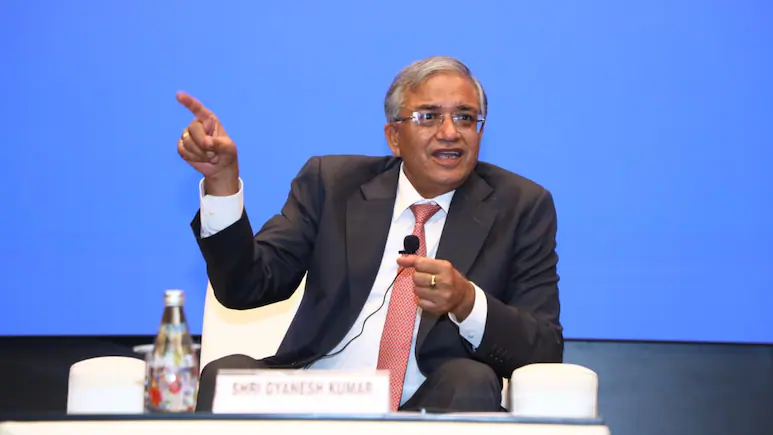
Chief Election Commissioner Gyanesh Kumar, during his official two-day tour to Gujarat, delivered a keynote address on conducting elections in the world’s largest democracy at the Ahmedabad Management Association. Addressing an audience of prominent citizens, academic leaders, and election officials, the poll body chief forcefully dismissed claims surrounding the possible vulnerability of Electronic Voting Machines. He emphasised that EVMs operate as standalone devices without any connectivity to electricity, Wi-Fi, Bluetooth, or infrared, rendering remote hacking technically impossible.
Chief Election Commissioner Gyanesh Kumarsaid that technology is increasingly being used to improve communication within the election machinery.
Polling agents representing political parties participate in a mandatory one-hour mock poll before actual voting. Every vote cast on election day is mirrored by a Voter Verifiable Paper Audit Trail (VVPAT). During counting, the EVM results are also verified in the presence of counting agents of candidates. “Integrated digital platforms such as ECI Net are being used for faster and more effective communication across the extensive election network. The session was attended by Gujarat Chief Electoral Officer Sandeep Sagale and AMA President Rajiv Gandhi.
Outside the lecture hall, the Chief Election Commissioner’s itinerary features administrative visits to Sabarmati Ashram and Adalaj Stepwell, along with review meetings with 500 booth-level officers at Gujarat University and 1,000 members of Electoral Literacy Clubs at Shela to reinforce electoral operational integrity.
“Across billions of counted votes, not a single mismatch between EVM counts and VVPAT receipts has occurred,” he said, adding that the rigorous mechanism ensures that Indian voting standards remain unmatched worldwide. “Booth Level Agents participate in the verification of electoral rolls, while mock polls are conducted on Electronic Voting Machines (EVMs) before actual polling begins,” he said. “A mock poll is conducted in the presence of representatives of candidates before voting starts, and actual polling begins only after the functioning of the machines has been verified,” he said. The CEC also added, “After polling, the total number of votes cast is recorded in Form 17C and the EVMs are sealed according to the prescribed procedure. CEC Kumar said that technology is increasingly being used to improve communication within the election machinery.
Communication that was earlier carried out through multiple applications has been integrated into a more effective digital system,” he added.
