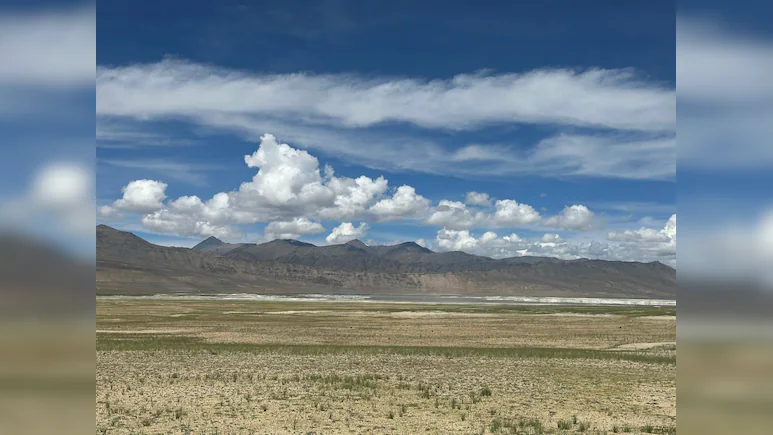
Tso Kar, one of Ladakh’s renowned high-altitude lakes, has experienced a dramatic reduction in size, losing nearly 70 percent of its area over the past decade. In response, the Union Territory administration has initiated a significant plan to channel glacier water into the lake, aiming for its revival within a year.
Its decline has also affected the fragile ecosystem around it, with fewer migratory birds arriving at the site and grazing grounds for local Pashmina goat herders shrinking. At present, this water flows unused into the Sindhu River. The administration expects the first water to reach Tso Kar in the first week of October. Instead, a simple earthen channel was chosen to divert the water to the first depression. The administration has described the project as the first attempt of its kind and scale in India to revive a dying lake at such a high altitude and under such harsh climatic conditions.
The lake, which was once spread across nearly 11,000 acres, has now been reduced to around 3,200 acres. The administration is now tapping an untapped source of water- the Rupsho Kharnak glacier stream, located at an altitude of around 18,045 feet. The stream is about 11.5 km from Tso Kar and is estimated to carry up to 132 cusecs, or around 320 million litres of water a day during summer. Around 20 cusecs of water from the Rupsho Kharnak stream has been diverted to the first depression since September 9. The administration said around 20 per cent of the depression had filled within four days. The water is being brought through an earthen channel as well as an old concrete canal at the site that has remained defunct since 1995. Work began on September 2, ahead of the onset of winter. One-Year Target The administration expects the glacier-water intervention to fully revive Tso Kar by around October 2027.
However, the administration said Saxena advised against building a new concrete channel, citing ecological concerns. Saxena said the project could serve as a blueprint for ecological restoration in high-altitude regions. “By redirecting the Rupsho Kharnak stream, we aim at bringing life back into Tso Kar Lake,” he said.
New Freshwater Wetlands to Form from Glacier Depressions
Recent developments indicate that three natural depressions will transform into new freshwater wetlands. This change will allow sediments carried by glacial water to settle before reaching the main lake. The formation of these wetlands is significant for local ecosystems, as they play a crucial role in water purification and habitat creation.
Under the project, the glacier water will be diverted towards Tso Kar using gravity and a series of natural depressions along the route. Work In Progress The project has moved from planning to execution. New Wetlands, Bird Habitats Officials say the intervention will have benefits beyond replenishing Tso Kar. The new water bodies are also expected to provide additional habitats for migratory birds and could emerge as new tourist attractions, being visible from the adjoining Leh-Manali Highway. Pashmina Herders Among Those Affected The shrinking lake has also had a direct impact on local communities. Officials expect the revival of the lake to help restore grasslands and grazing areas and bring economic benefits to the surrounding communities.
The first depression covers around 270 acres, while the second and third cover 24 acres and 10 acres respectively. The third depression is located just 400 metres from the lake. The three depressions are expected to hold around 1,230 million litres of water. Most villagers around Tso Kar are Pashmina goat herders, and the loss of grazing grounds has reportedly forced some herders to travel 50 to 75 km away from their homes in search of pasture. How Project Started Lieutenant Governor VK Saxena visited Tso Kar on August 10 and was informed by local villagers and the village head about the lake’s shrinking water spread and declining bird population. The Public Health Engineering department subsequently conducted a survey and submitted its report on August 30. The department had proposed an 11-km RCC channel to bring water to the lake.
Check dams fitted with RCC pipes will regulate the flow from one depression to the next before the water is finally channelised into Tso Kar. Tso Kar has historically been an important habitat for migratory birds, including the black-necked crane.