

Now, Chinese President Xi Jinping visited India to attend the BRICS Summit after nearly seven years. The coming together of the leaders of Asia’s two largest economies, after so long but within such a short time, is indeed a matter of great significance. What does it mean for the current state and the future of India-China bilateral ties? What are India and China up to while the global shifts? A complex negotiation has begun
After nearly five-years of diplomatic and military freeze post-2020 border clash, China-India relations seem to be turning a corner. It was in August 2025 when Prime Minister Narendra Modi visited China to attend the SCO Tianjin Summit, marking his first trip to the country since 2018.
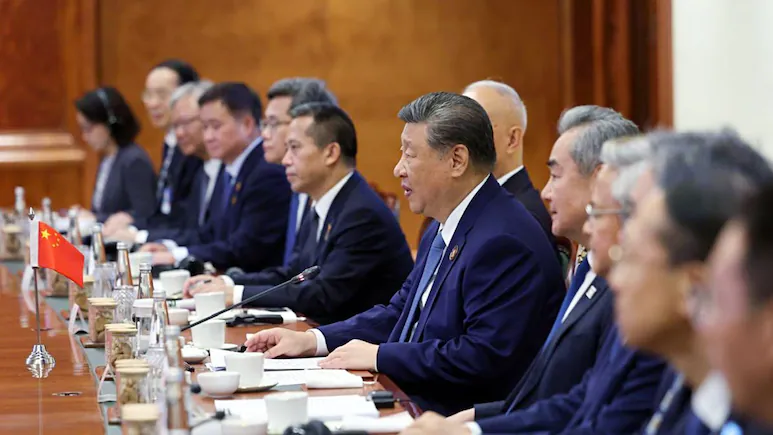
It is now clear that in today’s world of de-globalisation, only China has the ability to help India efficiently expand its manufacturing sector – and that is its biggest leverage in this negotiation process. Accordingly, both sides seem to have initiated a complex negotiation, encompassing every aspect of the bilateral ties, from border issues to economic relations and multilateral cooperation. India has apparently put forward three broad demands vis-~CHECK~-vis China – peace and tranquillity in border areas, fair market access/trade balance, and supply chain predictability. Meanwhile, China is building up pressure on India to more explicitly reiterate the ‘one-China’ policy, particularly with respect to Tibet and Taiwan; it’s also demanding more economic concessions in return for a stable border. A closer look at the official statements issued by both sides in recent high-level exchanges, including the recent bilateral, throws light on the issue. Meanwhile, India retorts that China’s current economic development is under tremendous pressure, as it is unable to generate domestic demand and is highly dependent on external markets and exports. At a time when relations with key trading partners, such as the US or the EU, are faltering, retaining the Indian market is absolutely critical for the Chinese, and that reinforces India’s bargaining stance.
Analysing the dominant discourse in both New Delhi and Beijing, it becomes apparent that in the context of the uncertainty emanating from Trump 2.0 policies, there is a growing consensus on both sides of the Himalayas that now is a rare window of opportunity for both sides to strike a quick bargain and risk-proof China-India relations from subsequent political changes in Washington. In terms of bargaining chips, China argues that India’s ‘China-decoupling’ strategy has actually failed, for bilateral trade is expected to reach a historic high of USD 155.6 billion.
In a multilateral platform like BRICS, although significant divergence continues to exist between Chinese and Indian positions on issues related to de-dollarisation, energy security, geopolitics, and relations with the West, there seems to be a new consensus emerging between the two sides. That consensus is in the context of the global geopolitical volatility, signalling that disagreements can be managed as long as the overall unity of the platform is upheld, that ‘China and India do not need to eliminate all differences to solve problems together’, and that ‘adversaries can also cooperate for a greater cause’. India endorsing the SCO joint statement and slamming the US and Israel for the war in Iran, as well as the BRICS declaration’s strong support for the Palestinian cause, can be explained from this emerging framework. However, as the BRICS baton passes to China and the focus shifts to the Belt and Road Initiative (BRI), the Global Development Initiative, Global Security Initiative, Global Civilization Initiativem and Global Governance Initiative, the new consensus between the two Asian rivals will surely be tested in the time to come. Overall, one can argue that the conditions are indeed ripe in both New Delhi and Beijing for a deep reset in bilateral ties. For China, the headwinds facing its domestic economy, its export dependence, and deteriorating ties with its key trade partners like the US and EU are critical challenges. No wonder both sides could achieve this quick turnaround in bilateral ties, which looked almost impossible a few years back. But at a time when both sides seem to be seeking to maximise their gains while reducing concessions, can they still find some common ground and reach a win-win bargain? That is something that remains to be seen.
In India’s case, deep dependency on the Chinese supply chain and the unpredictability of Trump 2.0 are important driving factors.
