
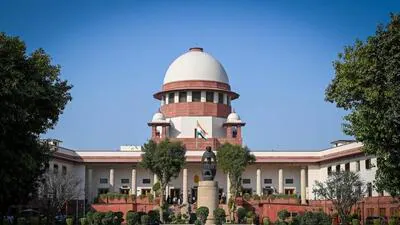
The Supreme Court on Thursday reserved its order on the Centre’s plea seeking prospective application of its March 11 judgment that held other backward classes (OBC) candidates cannot be excluded from reservation benefits solely on the basis of their parents’ salary income.
The court judgment came to be passed in a set of appeals filed by the Centre against orders passed by the Madras high court. In one such case, the high court permitted an OBC candidate to be treated as a non-creamy layer candidate which furthered his career prospects. The top court approved the high court order and discarded the Centre’s objection that his father worked with a multinational and having a high income, he would come under creamy layer. Similarly, the court permitted another candidate to obtain benefit under the Civil Services after he was initially refused OBC reservation owing to his father’s PSU employment which fetched higher income. Both the candidates argued that their parents were excluded on income criteria while for government servants, creamy layer classification was based on their parents’ posts by which Group A or B, C or D officers stood excluded as creamy layer.
“The Union government is only praying for a limited deferral of the operationalisation of the law laid down by this court for a period of two years so that the competing rights can be adjusted consistent with the administrative contingencies and an effective equivalence exercise is carried out.
Stating that the judgment’s operation to all appointments and admissions made in the past will result in a “complete administrative chaos” the Centre urged the court to make the decision to apply prospectively and requested for a two-year period to work out equivalent posts similar to Group A and B officers in the government for identifying creamy layer among persons employed with public sector undertakings (PSU) and private employment. The Centre led by solicitor general Tushar Mehta and additional solicitor general (ASG) Aishwarya Bhati said that the application does not question the judgment. It further said, “The application of the present judgment to past and ongoing recruitments will gravely prejudice the competing rights of persons who were not even a party to the present litigation and will result in reopening of seniority, cadre allocation of appointees and candidates and result in complete administrative chaos. They argued that similar “equalisation” based on posts should apply to OBC parents working in PSUs and private employment. The judgment said, “Treating the children of those employed in PSUs or private employment, etc., as being excluded from the benefit of reservation only on the basis of their income derived from salaries, and without reference to their posts (whether Group A or B, or Group C or D) would certainly lead to hostile discrimination between parties who are similarly placed and would amount to equals being treated unequally. The March judgment held that the evolution of the non-creamy layer principle demonstrates that both the 1993 office memorandum and 2004 letter preserves the “primacy of status- based exclusion” and confines economic exclusion to those falling under the sixth category. “Salary income cannot be mechanically aggregated in a manner that defeats the constitutional objective articulated in Indra Sawhney,” the court said while justifying its conclusion.
He was earlier recommended for Indian Police Service by the UPSC but under OBC reservation, he became entitled for allocation under the Indian Foreign Service.
