
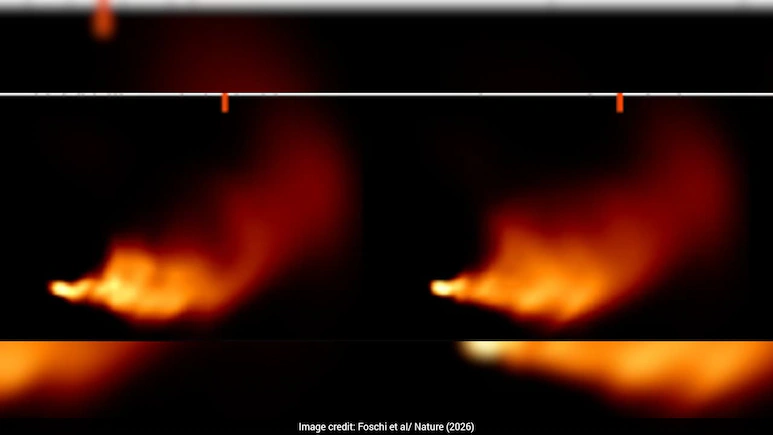
Astronomers at Caltech have pieced together a stunning video showing a powerful beam of high-energy plasma erupting from a supermassive black hole billions of light-years away from us, the New York Post reported.
The dynamic visualisation offers the clearest look yet at a distant “blazar”, which is a cosmic phenomenon where a supermassive black hole spews a jet of plasma straight toward Earth.
After that, they used AI to process the data. The software filled in the visual gaps over time, sharpening the clarity by about four times. The result allows scientists to continuously track the plasma’s movement rather than looking at isolated snapshots.
For the video, researchers analysed 116 radio telescope images gathered over 27 years, spanning from 1995 to 2022.
The findings, published in the journal Nature, centre on a well-known blazar dubbed “3C 345”, located about 5.5 billion light-years away in the constellation Hercules. The lead author, Dr Marianna Foschi, and her team developed a neural-network algorithm called “Kine”, instead of relying on traditional pixel-based image processing.
“We are all very excited by the amount of resolution and contrast that we can get thanks to our new algorithm. “But in this case, thanks to our algorithm, we get this basically for free. Because usually in astrophysics, to get better images, you have to wait for the next generation of telescopes with better lenses or better sensors,” Dr Marianna Foschi, who is the lead researcher, told KCRA 3, especially.
“In simple terms, we mapped the image with peaks where parts of the blazar appear brightest, and valleys in the parts that appear darkest,” Dr Foschi explained.
