
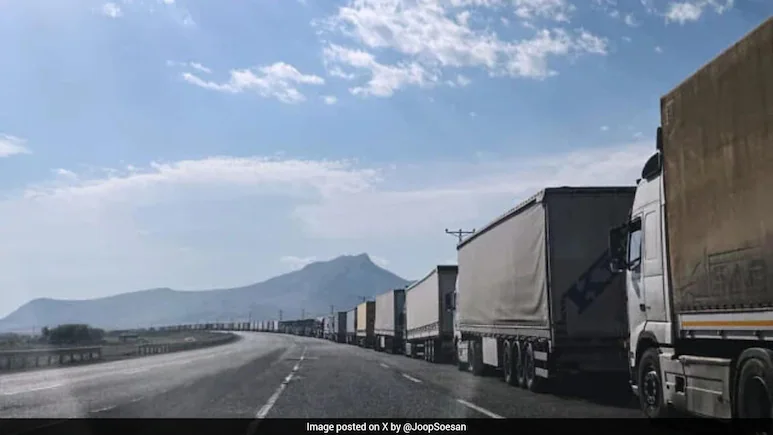
Hundreds of trucks idle along the road into Iran from Turkey’s mountainous eastern border. Bustling even in normal times, the countries’ largest crossing is now a make-or-break economic lifeline for Tehran as the US navy blockades its ports.
Iranian President Masoud Pezeshkian has pressed to accelerate overland trade as the blockade limits the vast majority of imports while cutting off the oil and gas sales that largely keep the economy alive.
The value of Iran’s currency, the rial, has sunk and inflation has soared since the US and Israel launched their war on Iran on Feb. And at the border between Iran and Pakistan, drivers also have reported delays. But an AP reporter visiting the Turkey border crossing on Tuesday saw road work aimed at building extra lanes. They also have agreements to open a new crossing at Kuhak, Iran’s state news agency reported Momeni as saying after his Pakistani counterpart visited Tehran on Monday. (Except for the headline, this story has not been edited by NDTV staff and is published from a syndicated feed.)
Iranian President Masoud Pezeshkian has pressed to accelerate overland trade as the blockade limits the vast majority of imports while cutting off the oil and gas sales that largely keep the economy alive. It’s the latest test of Iran’s endurance. Frustrated Iranian truck drivers spoke to The Associated Press at the Turkey border crossing, where lines now stretch for miles. We used to wait, maximum, for three days here. Iran accuses the US of trying to weaken the country. “They are trying to create difficulties wherever they can, and they are holding nothing back. Iran insists the pressure will not change its stance in negotiations with Washington. Tehran wants the US blockade to end before it allows commercial shipping to flow again through the Strait of Hormuz, where Iran’s grip has shaken global markets and oil prices. Iran has a huge challenge as it tries to shift trade from sea to land. Now Iran’s land crossings with Turkey to the west and Pakistan to the east are crucial in connecting with Europe and Asia. Drivers carry goods that are vital to Iran’s petrochemical and other manufacturing that were badly damaged by U.S. and Israeli strikes. But the land crossings are badly strained. “Logistics, capacities of these borders are limited. Overland trade “would not basically be able to substitute or compensate for the blockade. “Some Turkish drivers can bribe and get ahead of the line. Our money is worth nothing here. Many blamed longer inspections by Turkish authorities of trucks leaving Iran. “It’s a shame for us drivers here. There is no toilet or shower we can use here while waiting. Iran’s leaders have acknowledged the high stakes. Weeks before that, plummeting economic conditions had sparked anti-government protests that led to a deadly crackdown.
Because of the war, the waiting times exceed five days. Because it is not clear how long this situation will continue, ghanbari blamed the border backup in part on neighboring countries: “Destination countries are not willing to develop infrastructure. “I’ve been driving through this border gate for 15 years. I’ve never had to wait as long as now,” said Muhammed Riza Shiri, 55, who had waited four days to carry his load of rubber into Iran. “We had to wait at the end of a seven-kilometre (4.3-mile) line. Its economy relied on the gulf for over 80 per cent of its trade before the war, according to Iran economist Mohammad Farzanegan. Akbar Sadigi, 42, an Iranian truck driver from Tabriz waiting at the crossing, said longer waiting times have cut his twice-monthly trips to once a month. Fuel prices for his truck have risen by 25 per cent in Iran since his last trip, he added. Drivers said the customs line is even longer on the Iranian side, with wait times in the past month ranging from 12 to 25 days. The economy shrank by over 10 per cent in the three months following the start of Iran’s calendar year on March 20, compared to the same period the previous year, according to its statistics agency. Iran’s non-oil economy shrank by 4.6 per cent. 28. Iranian Interior Minister Eskandar Momeni this week said the countries plan to boost flows by keeping crossings open 24 hours a day.
They are closing off routes, shutting down air routes, blocking land routes and trying to fuel internal divisions,” President Masoud Pezeshkian said Tuesday. Regulations, border controls, corruption, all these things would make the transit much more difficult and time-consuming,” Farzanegan said. At Turkey’s Gurbulak border, truck waiting times have more than quadrupled since the war began, according to data from the International Transporters Association, which represents Turkey’s international logistics sector. One Iranian official said the number of trucks has shot up. “Instead of 200 trucks, there are 1,200 trucks at the border, and the destination country does not have the capacity to accept this number of trucks,” Amir Roshanbakhsh Ghanbari, deputy head for a government agency that promotes Iranian trade, said in an interview with a semiofficial news outlet, ILNA. Two staffers from a local road authority, who spoke on condition of anonymity as they were not authorized to comment publicly, said Turkey was improving border infrastructure based on a three-year-old plan. “With the rising costs, increased maintenance expenses, high prices for tires and parts and, on the other hand, reduced cargo loads and decreased driver income, it has become very difficult for many of us to continue working,” one message read, warning truckers “will not remain silent in the face of this increased pressure on drivers. “I make half of what I used to make because of this,” he said. We can’t do that,” Sadigi said. Akbar Yahyai, an Iranian truck driver who said his loads vary from machinery parts to chemical components, said he had been waiting four days. You can see it from how we look and smell,” he said, adding that he barely makes enough money to eat. Officials in Iran and its neighbors said they are trying to speed up border crossings. “The Turkish customs have deceased the waiting times of vehicles coming from Iran from 30 to 22 days by increasing the number of lanes at fuel measurement stations and doubling X-ray scanning machines,” Ersin Simsek, Gurbulak representative of the International Transporters Association, said in a phone interview.
