
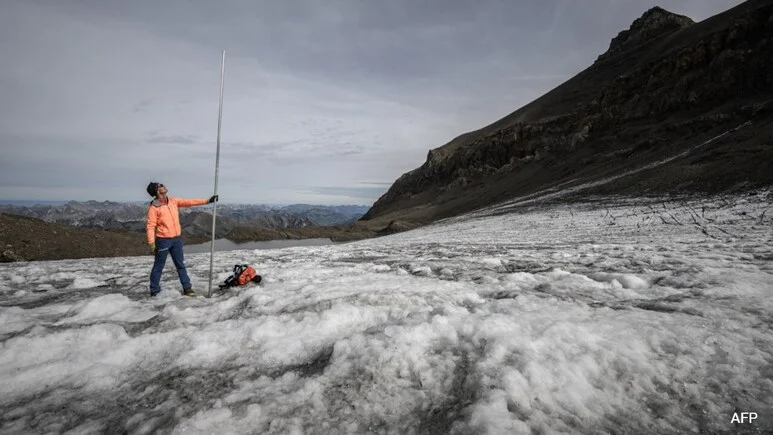
The alpine country has lost almost one-fifth of its ice in just five years, a new study has found. The extreme heat that Europe is experiencing this year is taking a toll on the glaciers in Switzerland. The primary reason for the rapid ice loss is that Europe is warming twice as fast as the global average due to heat-trapping, atmospheric and air quality shift and fossil fuel pollution.
Carried out by GLAMOS – short for Glacier Monitoring in Switzerland – some glaciers have seen unprecedented loss eclipsing the numbers from 2022, the worst meltdown year on record.
“We just need to stabilize the climate by reducing CO2 emissions and this will help the glaciers,” said Huss, of GLAMOS, though he added that it is “almost too late” to save those in the Swiss Alps.
Europe is warming faster than the global average, making such extreme heat increasingly consequential for the Alps. The result was a rapid loss of glacier mass. Scientists say extreme melt years are becoming increasingly common across the European Alps. But rising temperature is threatening ice masses across the world. These ice structures act as seasonal water stores, releasing meltwater when temperatures rise and rainfall is low.
Because its dense concentration of Alpine ice mass has been systematically measured for over a century, providing critical insights into global climate change, switzerland serves as a natural laboratory for glaciers. Because they are not simply frozen landscapes, melting of glaciers is significant. And his fears are not unfounded: Scientists have seen some glacial tongues have lost as much as 10 metres (or 33 feet) of ice in the first eight months of 2026. Glaciers worldwide lost around 450 billion tonnes of water in 2024, while global glacier loss has accelerated dramatically, according to United Nations.
Glaciologist Matthias Huss, who also leads GLAMOS, told Washington Post he feels the glaciers are evaporating before his eyes.
