
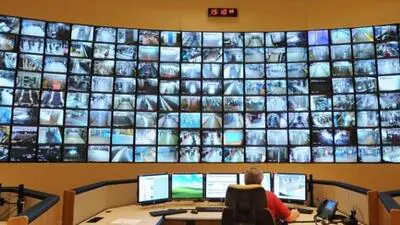
Digital rights experts and privacy advocates have raised concerns about the government’s plan to set up 2,500 AI-enabled cameras in the national capital, warning that the project could expand into an unchecked surveillance apparatus without a data protection framework.
The cameras will do more than just track vehicle speed or stop-line violations. They will be able to spot a rider without a helmet, use of mobile phones while driving, a car going the wrong way, illegal parking or a vehicle on a police hot list, feeding all the information to a central command centre, a police control room that will monitor the whole network live. AI-based analytics by the police will also help identify stolen, hot-listed and blacklisted vehicles, repeat violators and vehicles connected with hit-and-run incidents. Everything will feed into Traffic Command and Control Centres, which will bring traffic regulation, enforcement and public information onto one common platform. “We must explore the use of technology to improve road safety and prioritize ambulances. But Intelligent Traffic Management System goes considerably beyond adaptive traffic signals. Before deployment, Delhi Police and the Government should publish the project’s privacy and data governance framework. Three committees, led by the Union home secretary, the Delhi police commissioner and the special CP (Traffic), will oversee the project. Delhi Police will implement the project through a Master System Integrator, a private firm selected through competitive bidding to build and run the system. C-DAC will act as project management consultant, handling technical scrutiny, monitoring, validation and acceptance. The government has underlined that the system would have a secure data centre, an encrypted network, and audits by CERT-In-empanelled auditors.
Apar Gupta, founder of the Internet Freedom Foundation, said, “As a resident of Delhi, I know that its commuters actually need shorter journeys, which is due to the virtual invisibility of any traffic police and compounded by illegal parking which is now done in an organised manner. The system will use open standards and APIs so that other systems can be plugged in later. How it will be built The project, which is due to start within eight months, covers 1,092 traffic intersections where signals will adapt to traffic (Adaptive Traffic Control System locations).
The ₹ 1,789.52 crore project is part of an Intelligent Traffic Management System (ITMS) the Union cabinet cleared on Wednesday. Deputy Commissioner of Police (Traffic-Headquarters) Shive K Singh told HT that the 2,500 new cameras would be installed and linked to a central command centre with the existing camera networks of the traffic police, Delhi Police and the National Highway Authority of India. Delhi Police has about 25,000 CCTV cameras deployed, while the traffic police operate 209 red-light and 125 over-speed violation detection cameras. Instead, the government has proposed spending close to ₹ 2,000 crores on digital surveillance and AI. Another 1,029 locations would be fitted with automated enforcement equipment. The project will be executed in three phases over 24 months across 42 corridors, followed by five years of operation and maintenance.
‘Surveillance infrastructure’ However, digital rights groups said the concern is less about the technology than the missing detail. They will be backed by a secure data centre and a disaster recovery site, a government statement on the cabinet decision said. Discussions are also with navigation providers such as Google and Apple, which run their own maps and route alerts for sharing this information, officials said. Delhi needs better traffic management but with clear limits on what the resulting surveillance infrastructure can be used for,” she said. The government has not said what role the selected integrator will play in handling data during the five-year operation and maintenance period.
Gupta also raised concerns about the missing rules on the data that will be collected. “Worse, it is silent on what is stored, for how long, and who gets access. With Delhi Police as operator and open APIs promised for ‘future integration’, this is surveillance infrastructure being built that will also be opened up in the future to a private ecosystem of insurance and ‘challan’ settlement companies. In short, it will be a foolhardy burden on the public exchequer which will only put people to greater threat by digital data collection.
Now, 700 such cameras will be deployed at the station, he said.
Mishi Choudhary, founder of digital rights legal group SFLC.in, said the government must release the project’s privacy and data governance framework. IT minister Ashwini Vaishnaw, who announced the project at a cabinet briefing on Wednesday, said, “protocols, operating rules and regulations regarding this project will be made keeping citizens in mind” Vaishnaw, who is also the railways minister, referred to the installation of AI cameras at New Delhi Railway Station as a 7-8 month-long pilot project, saying it had resulted in a fall in crime.
