
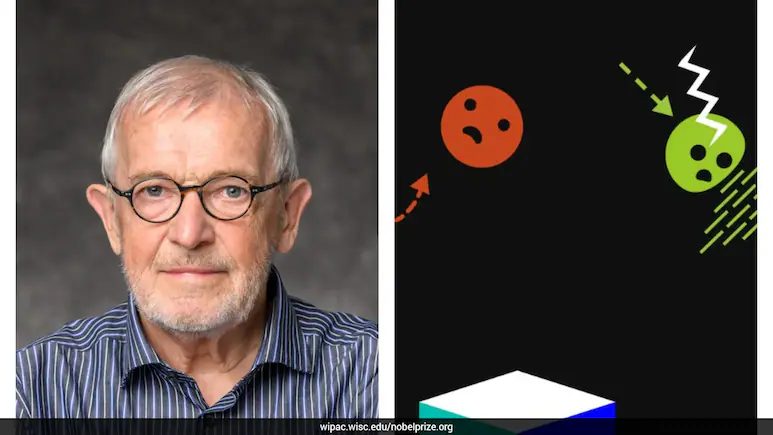
Neutrinos are among the most elusive particles known to science. They have no electric charge, an extremely small mass and interact so rarely with ordinary matter that trillions of them can pass through the human body every second without being noticed.
IceCube is a huge detector built into the clear ice beneath the South Pole. Scientists know of three types, or flavours, of neutrinos: electron, muon and tau neutrinos. Remarkably, a neutrino can change from one flavour into another as it travels. This phenomenon is known as neutrino oscillation. The discovery of neutrino oscillations also showed that neutrinos have mass. Takaaki Kajita and Arthur B. That ability to pass through matter almost unnoticed explains the ghost-like description. Scientists cannot simply observe a neutrino travelling through space. Instead, they wait for the rare occasions when one interacts with another particle. IceCube has thousands of light sensors embedded deep beneath the South Pole. When a neutrino happens to interact with matter in the ice, it can produce charged particles which create a tiny flash of light. The sensors record that light and allow scientists to estimate the neutrino’s direction and energy. For Halzen, the significance goes beyond finding a difficult-to-detect particle. His work has helped open what scientists describe as a new window on the universe. The basic paradox of neutrinos remains what makes them so valuable: they are almost impossible to see, yet they can carry information from some of the most distant and violent places in the cosmos.
The Royal Swedish Academy of Sciences awarded Halzen the prize on 6 October 2026 for his decisive contributions to the IceCube Neutrino Observatory and the discovery of high-energy neutrinos of astrophysical origin. McDonald received the 2015 Nobel Prize in Physics for the discovery of this phenomenon. IceCube’s discovery of high-energy astrophysical neutrinos in 2013 helped establish neutrino astronomy as a new field. Later research has produced evidence linking neutrino emission to galaxies including TXS 0506+056 and NGC 1068, also known as Messier 77.
Their almost invisible nature has earned them the nickname “ghost particles”, a description used widely by scientists, including Francis Halzen, the physicist whose pioneering work on neutrinos has now been recognised with the 2026 Nobel Prize in Physics, according to the Institute of Physics .
