
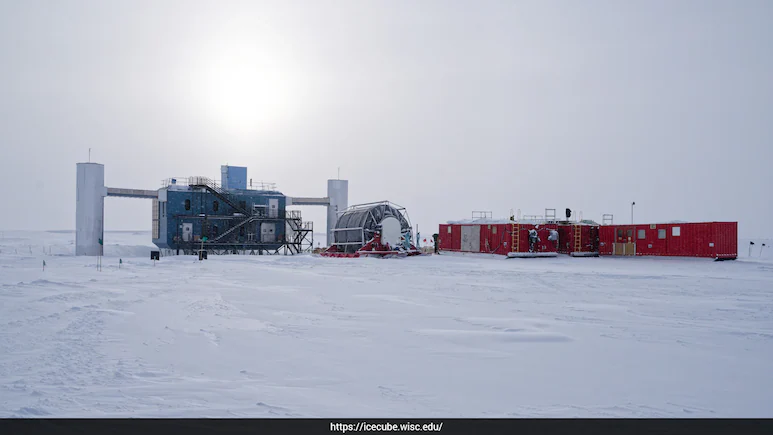
Halzen’s work helped transform a huge volume of ice beneath the South Pole into a giant detector capable of observing some of the most elusive particles in the universe. Belgian-American physicist Francis Halzen has won the 2026 Nobel Prize in Physics for his decisive contributions to the IceCube Neutrino Observatory and the discovery of high-energy neutrinos of astrophysical origin.
The Royal Swedish Academy of Sciences said his vision and scientific leadership were fundamental to the development of IceCube.
The sensors buried in the ice can detect these flashes. Scientists can then use the signals to work out the direction from which the neutrino came and investigate the cosmic event that produced it. Scientists hope to use these particles to study some of the most energetic environments in the cosmos, including distant galaxies and other extreme astronomical objects. IceCube’s observations have allowed researchers to detect high-energy neutrinos arriving from beyond the Solar System. The particles act as cosmic messengers, giving scientists information that cannot always be obtained from ordinary light-based telescopes. The observatory has also detected neutrinos associated with our own Milky Way, adding another way for researchers to study our galaxy. IceCube’s work is continuing.
BBC reported that Halzen first presented his vision for detecting neutrinos at the South Pole in 1988. An upgrade to the observatory was installed during 2025 and 2026 to improve its sensitivity and the accuracy with which scientists can determine the direction of neutrinos.
Nobel Committee for Physics chair Mark Pearce described his work as providing scientists with a “fantastic instrument” and said his scientific vision had helped create a new form of astronomy.
