
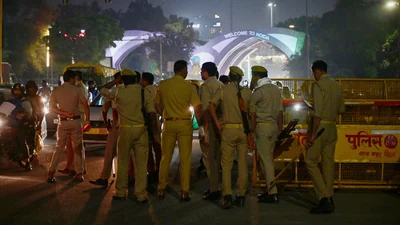
Authorities on Friday imposed curbs without precedent in the Capital, ordering the gates of 45 metro stations shut, cutting mobile internet across a swathe of central Delhi, cancelling trains into the city and bringing in paramilitary reinforcements by special train, even though the Supreme Court directed the Centre and Delhi Police to lift blanket restrictions on public transport, observing that “you will not use a hammer to kill a fly”.
Delhi Police on Friday denied the Cockroach Janta Party (CJP) permission to protest at Jantar Mantar on Saturday, setting off a security operation that by Friday night reached well beyond the Capital. The metro stations will be closed till 6pm on Saturday, DMRC said. The Gen Z-led movement, behind one of India’s biggest student protests in years, whose agitation ended with the education minister’s resignation in July, is demanding that Chief Election Commissioner Gyanesh Kumar step down over the Special Intensive Revision (SIR) of electoral rolls. It also cited reports of women constables being molested and assaulted by people taking part in protests at Jantar Mantar over the past week.
Joint commissioner of police Nupur Prasad said the CJP applied on October 7, three days before the proposed gathering, against a rule requiring 10 days’ notice, and that its July demonstration had raised concerns over compliance with police directions. The statement said the group’s protest at the site in July, permitted for one day, ran for about a month, during which more than 200 police personnel were injured and over 2,000 people with criminal antecedents had reportedly taken part. Initially, the Delhi Metro, acting on an order, announced entry and exit at 57 stations were to close from 9pm on Friday until further notice. After the court’s order, the DMRC cut the list to 45 stations but key central Delhi stations remained on the list. On the roads, Delhi Traffic Police said it will divert vehicles at up to 30 points ringing central Delhi from 6am on Saturday, from Dhaula Kuan in the south-west to Mandi House in the east, and has asked residents to avoid non-essential travel — virtually closing off all of central Delhi. To be sure, central Delhi has been locked down before, most recently for the G20 Summit in 2023, but the Capital has rarely, if ever, seen curbs on local and interstate transport, business activity and mobile internet imposed together, with police and the CISF also collecting the travel details of people headed for the city by air. The metro closures announced on Friday took in more than one in five of Delhi’s 271 stations, and the revised list still takes in one in six.
Citing the previous stir, the DCP (New Delhi district) said, in a letter on Thursday, that the grant of permission to protest could lead to “serious law and order problems again”. Delhi Police, in a statement on Friday, called the restrictions “temporary and precautionary in nature” and said Jantar Mantar could safely hold about 1,000 people at a time. Hearing a petition by Communist Party of India (Marxist) general secretary MA Baby, the court said authorities could regulate the movement of trains to prevent unlawful gatherings but could not bring the system to a halt and inconvenience millions of ordinary residents.
