
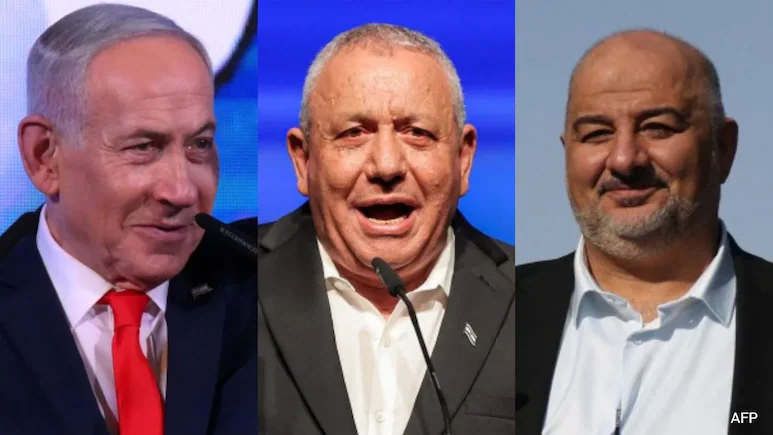
The final results of the 2026 Israel election are out, and no single party has a decisive lead to form the government for the 26th Knesset. The Jewish nation faces weeks, possibly months, of political limbo to reach the required 61-seat majority to form a government in Israel’s 120-seat parliament. Prime Minister Benjamin Netanyahu’s coalition of right-wing and far-right parties won 53, with his Likud party remaining the largest faction with 27 seats. The opposition bloc, led by centrist Gadi Eisenkot, secured 48 seats.
Another Election
The fragmented outcome sets the stage for difficult negotiations to form a government that could last weeks, as deep-rooted political and ideological divisions make any seemingly straightforward coalition almost impossible. Still, it is not impossible, even if the result is a tenuous alliance that survives little more than a year or so in office. Five Ways Israel Can Break the Election Deadlock One possibility is that Netanyahu’s Likud party, emerging as the largest in the Knesset, forms a coalition that would likely include centrist and right-wing opposition parties such as Gadi Eisenkot’s Yashar, the second-largest party, Avigdor Lieberman’s Israel Our Home and Naftali Bennett’s Together faction. Further, the opposition parties would also have to break their main election pledge to their voters: unseating Netanyahu. Still, if neither camp is able to form a government at the end of weeks of protracted negotiations, a unity government may emerge as a last option. Renewed fighting with Iran, or other players, could also push the sides together. Given his double victory, both as the leader of the largest party and heading the larger political bloc, it is unlikely that Netanyahu would agree to a power-sharing rotation. Still, the possibility cannot be ruled out that he agrees to a deal with Eisenkot’s bloc where the top post goes up for rotations. Under this scenario, the leaders of the change bloc would again have to break their promises to voters and serve under Netanyahu. But Israel’s longest-serving leader is viewed as one of its most skilled politicians, and he could split the opposition by peeling away members of its parties and bringing them over to his side. But the coalition he was battling at the time had a far narrower lead, and he did not need too many defectors to destabilise his political rivals. If Herzog taps Eisenkot first, he could try to form a government with Yashar’s natural allies — together, the Democrats and Israel. Our Home — propped up by Israel’s two Arab parties, even if they are not members of this government: Ra’am and the Joint List. Netanyahu has focused his campaign on delegitimising support from Arab parties, who surged to record heights in Tuesday’s election, and for now, only The Democrats, a centre-left party, has come out publicly calling for their inclusion. Both Arab parties have signalled that they are prepared to cooperate with Eisenkot’s camp. After the formal final election results are published next week, Israel’s President Isaac Herzog begins consultations with party representatives and then taps the candidate whom he deems to have the best chance to form a government. If the candidate fails, another can try, and if that candidate fails, the Knesset can nominate another. If no one succeeds, another election is held.
Because it would mean Netanyahu would likely have to abandon his natural political allies, the far-right and ultra-Orthodox Jewish parties, however, this option appears remote at this point. The results from the Central Elections Committee also cemented the emergence of the Arab party groupings Raam and the Joint List as potential kingmakers, with the two winning a combined 19 seats. If party leaders are unable to forge a pact in the next 12 weeks, then Israelis will be back at the polls. Such a grouping would secure 66 seats, a majority in the 120-seat parliament. Netanyahu’s coalition has fallen from its original 64 seats to 53, according to the latest election results. He has managed to do this before, including as opposition head in the run-up to the 2022 election, which he won. Eisenkot’s camp would number 48 seats, according to the latest vote tally, with the Arab parties numbering 19 seats that together reach a 67-seat majority. But even if Eisenkot reverses his campaign pledge not to have Arab parties in government and accepts their support, it would be a hard sell to many Israelis whose attitudes toward Israel’s Arab minority have hardened further since the October 7, 2023, Hamas attack. Ra’am joined Bennett’s government in 2021, the first time an independent Arab party entered an Israeli coalition. That government collapsed after 18 months. There is a deadline for the process of around 100 days.
Herzog earlier this week said that everything must be done to avoid another election and urged the parties to come with an open mind to the consultations with him.
