
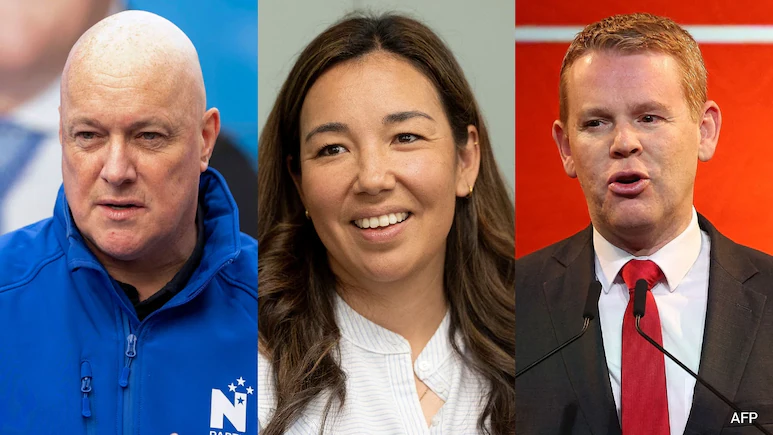
New Zealanders vote this week in a poll dominated by concerns over rising living costs and the state of the economy.
Opinion polls suggest the race is close, with neither the ruling National Party nor the opposition Labour Party likely to win an outright majority. Here are the key players in the knife-edge vote. But he has been unable to reverse his party’s slide in the polls, with gaffes, coalition divisions and rising living costs denting his popularity. Former prime minister Chris Hipkins succeeded Jacinda Ardern as Labour leader but hasn’t quite inherited her star quality. Instead, he has portrayed himself as an everyman, joking about his poor dress sense, love of sausage rolls and passion for DIY. The straight-talking Hipkins is seen as personable and a safe pair of hands. He has declared himself a follower of Stoicism, the ancient Greek philosophy that urges people to focus on what they can control. Labour have promised help with living costs, from free doctor’s visits and prescriptions to a cap on public transport fares.
Former Air New Zealand boss and teetotal millionaire Christopher Luxon has led New Zealand since 2023.
National hoped he could repeat the “glory days” under John Key, who won three elections for the party and served as prime minister from 2008 to 2016. Luxon has told AFP he sees himself as a “super salesman” for the country, and vowed to push for more free trade deals if re-elected.
Qiulae Wong’s centrist Opportunity Party, or TOP, is polling around seven percent. But with the election on a knife-edge, that has cast Wong as a potential kingmaker. She has also promised greater action on climate change, reforms to the struggling healthcare system and a kinder style of politics. NZ First leader Winston Peters may be in his eighties but remains one of New Zealand politics’ most colourful and controversial figures. That outburst sparked a rare complaint from the Chinese embassy. NZ First has promised populist policies ranging from swingeing immigration cuts to withdrawing from the Paris Climate Accord. Seymour rose to prominence campaigning against measures aimed at increasing New Zealand’s indigenous Maori minority’s role in governance and for sweeping cuts to state spending and taxes. He infamously joked about sending 17th century bomber Guy Fawkes to the country’s Ministry for Pacific Peoples, which he has pushed to abolish. On the other end of the spectrum are the Greens, New Zealand’s third most popular party. Jointly led by former government minister Marama Davidson and millennial trailblazer Chloe Swarbrick, they have taken inspiration from New York Mayor Zohran Mamdani’s plan for a publicly run supermarket chain. They have also pledged a wealth tax and to spend billions more on healthcare spending. As the country’s second most popular left-of-centre party, their support will be key if Hipkins is to become prime minister. (Except for the headline, this story has not been edited by NDTV staff and is published from a syndicated feed.)
The former consultant has pledged to introduce a universal basic income of up to NZ$370 (US$208) a week, funded by a land tax. But the two have governed together in an uneasy conservative coalition led by Luxon since 2023, united by a shared delight in provoking the left. Seymour’s ACT party is polling at 10 percent and would be a key player in any right-wing coalition.
“We expect politicians to bring people together, not divide,” she told AFP. Praised for his statesman-like style as foreign minister, Peters cuts a less diplomatic tone at home, disparaging opponents as “cuckolds” and “morons”. He drew outrage this year when he told a Chinese-born lawmaker to “go back to your own country” during a heated parliamentary debate. Luxon called it “very offensive” but did not sack Peters. David Seymour, right-wing provocateur The Siskel to Peters’ Ebert, Deputy Prime Minister David Seymour once described his right-wing rival as “the least trustworthy person in New Zealand politics”. And a turn on “Dancing with the Stars” back in 2018 saw him dubbed the “twerking libertarian”. The party drew condemnation last month when some candidates were photographed alongside members of the “Mongrel Mob” organised crime gang.
