
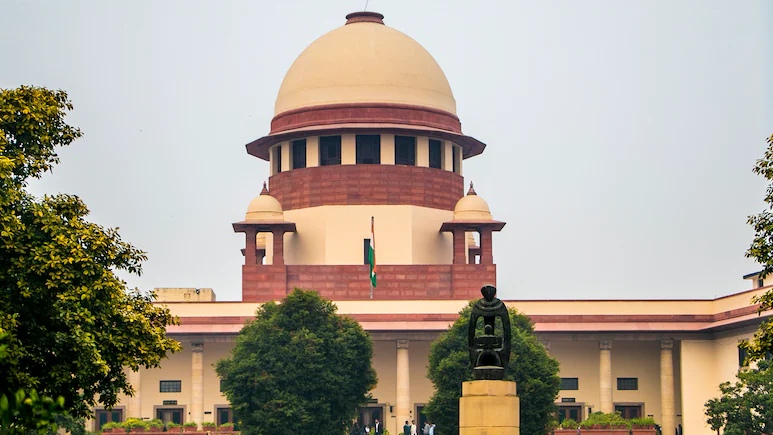
The Supreme Court on Wednesday observed that India’s demographic landscape has undergone a significant transformation over the past two decades, and hence laws disqualifying individuals with more than two children from contesting elections may no longer be relevant in the present context.
The court observed that a fertility rate falling below the replacement level will impact the country’s demographics in the future.
Justice Narasimha remarked that laws which penalise individuals for having more than two children have lost their relevance While delivering the order. The court observed that such laws exclude an entire class of citizens from political representation, even though having more than two children has no direct bearing on an individual’s capacity to hold public office. Observations on reproductive freedom and the right to contest elections: The court noted that such provisions force individuals to make an unacceptable choice between having children and participating in the democratic process. Narasimha observed. If we fail to take note of such demographic changes, India will face serious consequences,” Justice Narasimha, who authored the judgment, observed.
Earlier reporting noted: “Therefore, laws limiting population growth have lost its relevance. In that 2003 judgment, the provision under the Haryana Panchayati Raj Act, 1994 – which disqualified individuals from contesting Panchayat elections if they had more than two living children – was upheld as constitutionally valid. In 2003, India’s Total Fertility Rate was 3, it has since declined to 1.9. A fertility rate of 2.1 is considered the ‘replacement rate’ – the level required to keep a population stable.
This will lead to an increase in the proportion of the elderly population and a decrease in the share of the working-age population, the court said. In this context, the court said, it is necessary to re-examine the laws enacted with the objective of curbing population growth. Earlier reporting noted: “The foundation of such laws, that is the fear of overpopulation, has crumbled due to demographic changes in the past few decades,” a Bench headed by Justice P.S.
