
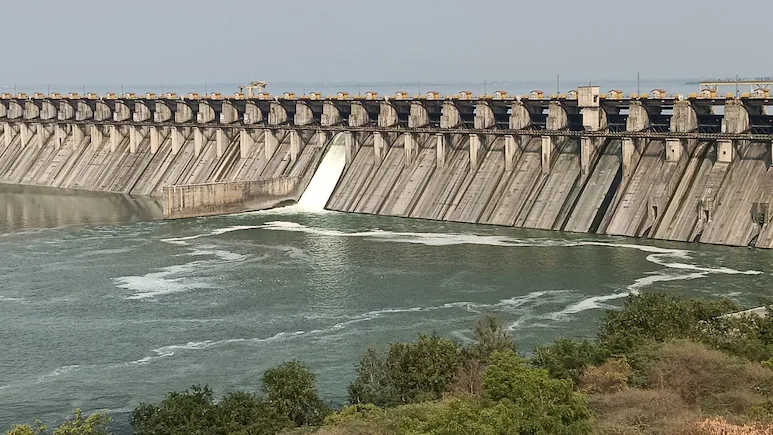
Standing on the banks of Solapur’s Ujani Reservoir, the breeze carries both the scent of fresh irrigation water and intense political debate. But on the ground in rural Maharashtra, local farmers, fishermen, and political leaders have raised red flags, fearing these massive projects will swallow up precious local resources.
Across India, data centers are often called the “digital kitchens” powering our daily online lives, artificial intelligence, and data security.
the updated plan aims to balance Maharashtra’s digital growth without sacrificing its vital agricultural roots While building complete trust with local farmers and fishermen will take time and complete transparency. The administration insists these worries stem from old technology. Power for the data centre will be pulled directly from a high-voltage grid line, ensuring that rural electricity meant for farms and homes remains completely untouched.
The water usage is capped at 0.50 TMC per year, less than 1 per cent of the dam’s total capacity. Land acquisition worries have also been addressed; the 568 hectares needed for the onshore facility belong entirely to the state irrigation department, meaning no private farmland will be taken away from villagers. For fishermen, the 3,000 hectares of floating solar panels will take up only about 9 per cent of the reservoir near the dam wall, leaving over 90 per cent of the lake still open for fishing. On power and jobs, official numbers show that the facility will generate around 2,800 permanent jobs, alongside thousands of indirect opportunities during construction and local supply-chain operations.
Collector Karthikeyan explained that the project will strictly use a “closed-loop dry cooling” system, where water is continuously recycled in pipes instead of evaporating. In fact, the floating solar panels covering parts of the water will reduce natural evaporation, actually saving more water than the data center consumes, he said.
The political clash reached a high point when NCP (SP) MLA Rohit Pawar strongly criticised the development, alleging that Maharashtra is being turned into a dumping ground for resource-hungry projects while employment-heavy semiconductor factories go to other states. The early plan included four major parts, most notably a Green Hydrogen plant and a Small Modular Nuclear Reactor. Local communities panicked over fears of nuclear radiation risks and chemical waste polluting the primary drinking and irrigation water source for thousands of families. To get to the facts behind the controversy, NDTV spoke to District Collector S Karthikeyan at the project site. Despite these updates, local anxiety about water and land usage remains a sensitive topic.
He said the green hydrogen plan was scrapped due to technical issues and potential pollution risks, while the nuclear option was completely ruled out. At the centre of the storm was an initial Memorandum of Understanding (MoU) signed in April 2026 for a Rs 1.65 lakh crore project. The original MoU is now being revised to focus on just three components: a 1,400-MW AI data centre, floating solar panels, and a battery storage facility. Protesters had warned that cooling a massive data centre could drain up to 7 TMC of water, virtually drying up the dam.
Other critics dubbed the initiative a form of “pollution colonialism”, alleging that high-tech hubs will gobble up local water and power while giving very little back to nearby villages. Addressing the biggest worries, Karthikeyan said the state government is officially scaling back the original proposal to protect local interests. “Neither a nuclear reactor nor a green hydrogen plant is going to be built here,” he clarified.
