

Midterm elections in the US are a critical referendum on the sitting American President and his policies. Rarely, though, has an incumbent so willfully put himself in the spotlight in defiance of his own popularity.
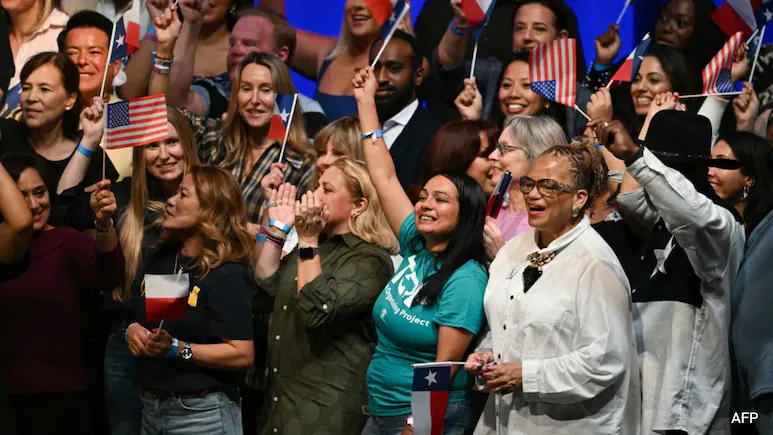
Even in some of the deeply conservative parts of southern and rural America, where Republicans were untouchable for decades, Democrats flipped these seats and won comfortably. Further, the real turning point came when the US President launched the war with Iran, leading to a surge in energy prices that sparked fury among American voters who had already faced years of cost-of-living pressures and believed his pledge not to start new wars. When it came to polling day, Americans seem to have humbled Trump and his Republican Party by savagely rejecting his party’s agenda in key battleground states and districts, swinging these back to the Democrats quite comfortably. The key epicentre for this rout was thus in the Republicans’ own backyard: the Southern states. Texas, a hardcore Republican base, saw Democrats winning both the Senate and the governor’s office. The same happened in the House in Iowa, where three out of four seats were flipped from Republicans to Democrats after decades. Most of the candidates who were handpicked by Trump this election stumbled. The head-spinning turbulence in the day-to-day lives of Americans during Trump’s second term was enough to make this happen. The situation now is far from better. One reason for this is demography. The inevitable curse of American politics in the last few decades has been its bitter partisanship. Democrats and Republicans tend to conflate demography with destiny. Voters seem to have sorted themselves out along racial, geographical, and educational lines. In such a polarising scenario, Asian Americans and Hispanics, as America’s swing voters, offer critical dynamism in addressing this baleful trend. Compared to other ethnic voting blocs, their numbers are growing faster, while their ideology remains more fluid and their priorities less divisive. Not just in this election, their influence will spread across many more in the future, too. Looking at some of the key issues and the way the polling outcome has emerged, the country is moving to the political left once more. These two ethnicities are also the most open-minded politically when it comes to voting either way, which gives them disproportionate sway in determining the direction of voting during key polls. Trump, two years ago, did well to win a higher vote share among both these ethnicities across most states, despite his often-racist rhetoric, with both groups voting in larger numbers for him.
In Texas, South Carolina, and Kansas, all states where Trump and his party won by double-digit margins back in 2024, Democrats recorded huge gains, marking a sharp deterioration in Republican support in states once considered deep red. Voters in Kansas elected a Democrat for the first time since 1932. Ken Paxton handed Democrats a Senate seat in Texas for the first time since 1988. Trump and the Republicans won the White House and took full control of Congress on a mandate to quash the inflation that plagued Joe Biden, promising $2-a-gallon gas prices and 3% mortgages. White voters changed little between 2020 and 2024, while both Latinos and Asian Americans lurched hard to the right. They were then the fastest to turn against Mr Trump in early 2025. The margin of support for Democrats has risen by 17 points among Latinos and 14 among Asians since 2024, compared with ten for whites and five for Black voters, according to The Economist . Seventy percent of Republicans are hostile towards Democrats, and more than 80% of Democrats remain hostile towards Republicans. Latino voters’ share has risen from 9% to 16% in the past twenty years, while that of Asian Americans has risen from 3% to 5%.
The US President’s “Liberation Day” trade war in April 2025 undermined those stated goals, driving up the cost of US imports and keeping inflation at uncomfortably high levels. “For the left, the growing ranks of non-white voters seemed to ease the need to win over culturally conservative whites, while Republicans have feared that immigrants would secure lasting Democratic power,” as reported recently in The Economist .
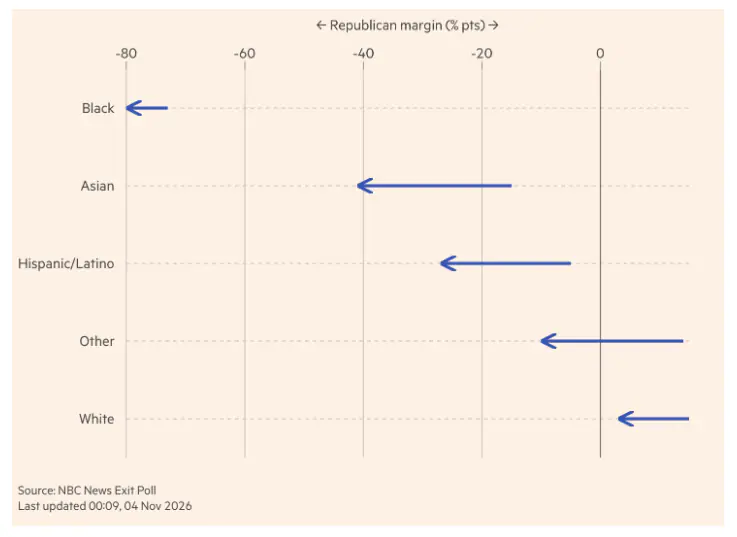
Some may ask why this is happening, and the answer is clear: jobs and the economy, the two key issues for both Asian Americans and Latinos, as reported here. However, his declining popularity was now being shaped by the mounting dissatisfaction among these groups. Polling puts Trump underwater on every policy, from inflation to immigration. Iran, inflation and inequality are the top issues for which voters blame Trump this election. Most surveys indicate that these two communities spend more time working than the average American.
As Democrats won in places like Kansas and Texas, the power of incumbency has made these key voter groups, and the issues they face, more competitive in future elections, too. younger voters swung the results more than older voters While the Democrats’ gains this election remained broad-based. Democrats also managed to bridge the gap between America’s most- and least-educated voters. In terms of ethnic groups, a key factor in the Democrats’ better performance across states, swinging them into power, was turnout among Black voters. Here, one may attribute this flip to the Supreme Court’s Louisiana vs Callais ruling, which weakened voting rights protections for most African-American voters. Another key swing-voter bloc this election, and perhaps the most decisive, was also among its most recent arrivals, given how Hispanic and Asian Americans have shaped this election and are only likely to do so more in future polls. This midterm, Trump has felt the wrath of these issues. This healthy competition needs to be welcomed with fresh hope for democratic agency and choice, which can allow the powers of any centralising authority or authoritarian leader to be restrained. (Deepanshu Mohan is Dean and Professor of Economics, O.P. Jindal Global University. He is a Visiting Professor at the London School of Economics (LSE) and a Visiting Research Fellow at the University of Oxford) Disclaimer: These are the personal opinions of the author
Young voters under 30, therefore, saw a 21-percentage-point move towards the Democrats. High prices, stagnant real wages, and a lack of ‘good’ jobs therefore hurt them more than anyone else. With 72% of those between 18 and 29 years old voting for Democrats, this was up from 54% seen two years ago. Georgia, for example, elected a Democratic governor for the first time since 1998. Back in 2024, when prices were the dominant issue, Latinos and Asian Americans became the perfect swing group. Back in 2022, Latinos were particularly exposed to the petrol spike, owing to their higher-than-average spending on cars, trucks, and fuel. Later, in 2023 and 2024, the effects of inflation shifted to housing costs, which adversely affected Asian Americans, who spend more on housing than other groups.
