
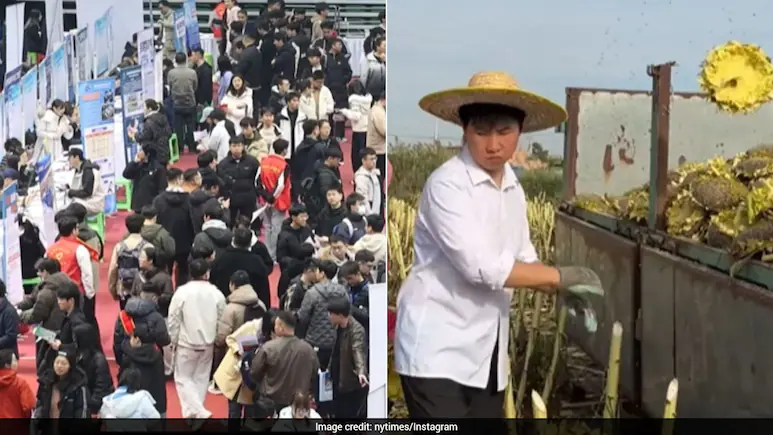
Facing fierce competition for jobs, recent college graduates in China are trading corporate careers for farming.
On Chinese social media, they are calling themselves xinnongren, which translates to “new farmers” in English.

With unemployment remaining high, many graduates have given up searching for jobs in major cities. The New York Times spoke to recent college graduate Wang Hongbo, who has been documenting his daily life on his family’s sunflower farm through videos and social media posts. His experience offers a glimpse into why some young graduates are reconsidering their career choices and life goals. Wang hails from Inner Mongolia, where his family has cultivated sunflowers for generations. He grew up on the farm and is the first member of his family to attend university. “My family never wanted me to go into agriculture. A movie enthusiast, Wang majored in filmmaking and secured what he considered a dream internship at a production company in Beijing. “In Beijing, the expenses are high, so after food and rent, there was not much left for anything else. After graduating, Wang returned home. he failed to secure a position Although he applied for dozens of corporate jobs. One day, while working alongside his father in the fields, he filmed himself dressed as an office worker. In the video, Wang appears stressed while trying to work on the farm. His father tells him, “You are nicely dressed, but messed up the work. Get out of here, go, go, go. The video garnered millions of views. “Seeing a suit on the farm is rare, so it created a visual contrast. A post shared by The New York Times (@nytimes) To reduce manual labour, Wang is modernising the family’s farming practices. He has deployed drones to spray pesticides and persuaded his father to try an AI-powered machine that determines the best time to water and fertilise crops. However, farming also comes with its challenges. “It’s been so windy and rainy that all the sunflowers got knocked down. Wang believes young people should make the most of available opportunities while continuing to develop their skills. “I think when there is an opportunity, you seize it.
Meanwhile, upgrade your skills in your spare time so that even if you’re unemployed, you still have a backup plan,” he said. They are among the 15 million (1.5 crore) people who have moved to the countryside in recent years to take up farming or start small businesses, according to The New York Times . However, the demanding work and a monthly salary of just $500 (approximately Rs 47,352) left him feeling burnt out. Wang now gets up at 6 am and works alongside his parents. Some local farmers now pay Wang a 20 per cent commission to sell their produce. He can earn up to $400 per livestream, and the money goes much further in the countryside than in a major city. “In Beijing, a single delivered meal was nearly $5. But here, $5 can cover a day’s worth of groceries to feed a family,” Wang said.
Local governments in China are also embracing the new farmer trend by offering tax breaks and loans to attract young people to rural areas, according to the report. Around here, they say, ‘Why go to college to then end up in the fields?'” he said. I was living paycheck to paycheck,” he said. I thought I would give it a shot, sharing our daily life in the fields on social media,” Wang said. “The older generation is still stuck in the mindset that farming is all about breaking your back in the dirt,” he said. Wang said his smartphone was his most valuable tool, allowing him to livestream and promote farm produce. Now we are propping them back up,” he said.
