
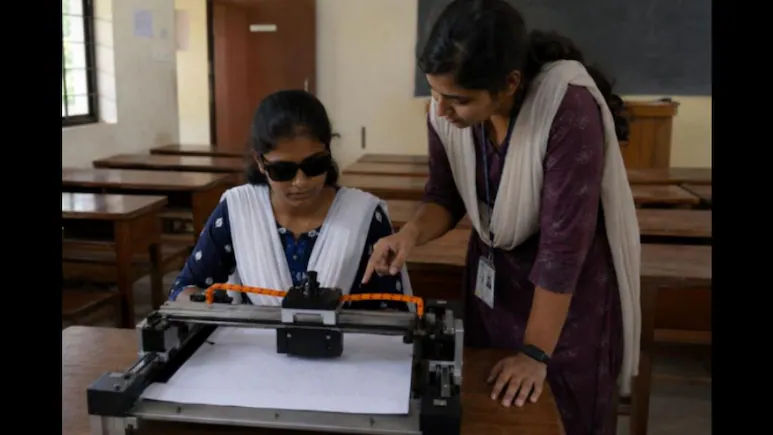
Lingampalli Himaja, a student from Chintalapudi in Andhra Pradesh’s Eluru district, has been awarded the India national stage of the James Dyson Award 2026. She developed RUDHRA, a groundbreaking voice-enabled Braille printer that translates spoken words into Braille, enhancing accessibility for visually impaired individuals.

Himaja, a student at Shri Vishnu Engineering College for Women, developed RUDHRA to help visually impaired people create Braille documents independently. The idea was inspired by challenges she observed while interacting with visually impaired students. The device uses voice commands to simplify the process of creating Braille documents. What does RUDHRA do? RUDHRA allows users to create, edit, and print Braille documents using voice commands. Spoken input is converted into text through Alexa, while a Raspberry Pi translates the text into reverse Braille patterns. A printing mechanism then embosses the required dots onto paper. By automatically generating reverse Braille patterns, RUDHRA eliminates the need for users to learn reverse writing techniques and reduces the physical effort involved in traditional slate-and-stylus writing. The device was developed based on feedback from visually impaired students. “After building my first prototype, one student asked me, ‘Why should I type when I can speak? She added that the award would also help her further develop the prototype through refinement and testing.
Speaking about the project, Himaja said the idea for RUDHRA began during a visit to a school for visually impaired students, where she observed the difficulties associated with traditional Braille writing. That simple question inspired RUDHRA’s evolution into a voice-enabled Braille printing system,” she said. Himaja said winning the James Dyson Award would give RUDHRA the recognition and visibility needed to reach institutions, communities and people who could benefit from the technology.
ViabilityX, a passive organ preservation and transport system created by Anvika Shetty of the National Institute of Design, Ahmedabad, was named the first runner-up. The backpack-worn system uses phase-change material cooling and a stabilising inner holder, while sensors provide live temperature and location updates through a companion mobile app. The system is compact enough to fit in an aircraft cabin overhead bin. Trike 2π, created by Shakeel Akthar S of Anna University, was named the second runner-up. It is a compact electric patrol vehicle designed to reduce patrol fatigue and improve security response in confined pedestrian environments. The three-wheel vehicle combines the stability of a four-wheeler with the manoeuvrability of a two-wheeler and can make tight turns within a five-foot radius. Its standing platform provides better visibility and allows quick mounting and dismounting. Independent suspension and integrated patrol features support security operations across large pedestrian areas. The top three Indian entries will represent the country in the international round of the James Dyson Award. The final winners will be selected by Sir James Dyson. The James Dyson Award is run by the James Dyson Foundation, a charitable trust established by James Dyson. The award encourages interest in design engineering among young people and provides recognition and support to emerging design engineers working on solutions to real-world problems.
As the India national winner, Himaja will receive approximately 5,000 pounds (Rs 6 lakh). The James Dyson Award invites students from 30 countries to develop practical solutions to real-world problems using engineering principles. The 2026 India edition featured innovations addressing a range of challenges. ViabilityX is designed to maintain organs at a temperature of 4°C to 8°C without electricity, batteries or ice.
