
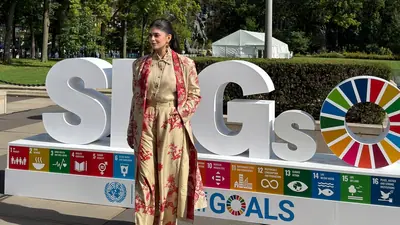
Actor and UNDP India Youth Champion Sanjana Sanghi addressed a high-level engagement at the United Nations in New York, calling for greater investment in education and healthcare and a bigger role for young people in shaping policy decisions.
Addressing the UN General Assembly, Sanghi lay emphasis on the capacities of today’s systems to give youth adequate resources and opportunities to shape their accelerated growth. The UNDP India Youth Champion also pointed out to the global military spending and deliberated over divergence of how even a fraction of this expenditure, if directed towards better healthcare facilities, education, vocational training and art centres could allow communities the means to tackle some of these challenges themselves. At the heart of her argument, she spoke about trust. Her message ultimately came down to the fact that young people cannot remain mere beneficiaries of decisions made for them when they are the ones who will have to live with what those decisions leave behind. Sanghi’s journey on the global youth stage began well before this latest appearance. Through her work with UNDP India, she has continued to champion youth inclusion, digital access and the Sustainable Development Goals. Her international work is not merely limited to individual UN appearances. Sanghi has served as a UNDP India Youth Champion and was named to the Millennium Campus Network’s Board of Advisors. What Sanghi carried to the UN was ultimately larger than a single set of demands. It was a vision of young people moving from the margins of policy conversations to their centre, equipped not merely to inherit the future, but to participate in building it.
In 2024, she opened the Action Days of the Summit of the Future, making the case for young voices to be heard where the decisions shaping tomorrow are taken. She was also part of the United Nations’ Distinguished Judges Panel for the 2025 Young Leaders for the SDGs cohort.
“Are we preparing our generations in a way that they deserve to be prepared?” she asked, reflecting on India’s large youth population and her own work in youth-led development. She said she believes that education can be a starting point for wider social change and drew from her personal experience of engaging vividly in youth-led work during her teens. “The real thing it comes down to is an acute poverty of trust,” Sanghi said, adding that she would rather see fundamental problems in education and healthcare addressed through collective action before young people reach a point where they have to take to the streets.
