
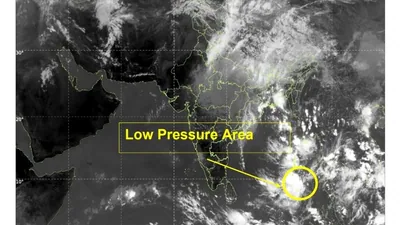
The India Meteorological Department ( IMD ) on Friday said a low-pressure area over the south Andaman Sea and adjoining Andaman and Nicobar Islands is likely to intensify into a depression by October 31 before moving towards the Andhra Pradesh coast over the following two days.
The new system has formed over the South Andaman Sea, close to the Andaman and Nicobar Islands, HT reported earlier. Thereafter, it is likely to move west-northwestwards towards the Andhra Pradesh coast over the subsequent two days. The development comes as the remnants of Cyclone Arnab continue to move further inland after weakening. A cyclonic circulation over the South Andaman Sea intensified into a low-pressure area in the early hours of Thursday.
In an update shared on X, the weather department said the low-pressure area, which was formed over the south Andaman Sea and its neighbourhood on Thursday, had moved west-northwestwards and lay over the south Andaman Sea and adjoining Andaman and Nicobar Islands at 8.30 am on Friday. The system is very likely to continue moving west-northwestwards and concentrate into a depression over the southeast Bay of Bengal and adjoining areas of the Andaman and Nicobar Islands and the Andaman Sea around October 31, the IMD said. It is likely to move west-northwestwards and intensify further into a well-marked low-pressure area over the Andaman Sea and adjoining areas of the Andaman and Nicobar Islands during the next 72 hours, HR Biswas, a senior scientist at the IMD in Kolkata, said.
Earlier reporting noted: Kolkata: After very severe cyclonic storm ‘Arnab’ weakened into a low-pressure area with continued impact on Kolkata and other parts of the state on Thursday, the Met office is tracking another weather system over the Andaman Sea, adjoining Andaman and Nicobar Islands. Earlier in February, a magnitude 4.6 earthquake struck the Nicobar Islands in the Andaman and Nicobar Islands, according to the National Centre for Seismology (NCS).
It is during these months that weather systems such as a low-pressure area and depression often intensify into cyclones,” said an official.
Earlier reporting noted: IMD’s cyclone forecasting and warning system is based on numerical weather prediction models, multi-model ensembles, advanced data assimilation techniques, and continuous monitoring using satellites, Doppler Weather Radars, ocean buoys, and coastal observational networks. Earlier reporting noted: “While April and May are known as the pre-monsoon cyclone months, October and November are known as the post-monsoon cyclone months.
However, the IMD has not yet forecast whether the system will intensify into a cyclonic storm. No cyclone warning has been issued so far. No reports of damage or casualties were immediately available. The Andaman and Nicobar Islands have experienced seismic activity in recent months.
A magnitude 5.1 earthquake struck 218 km north-northwest of Bamboo Flat in the Andaman and Nicobar Islands on Thursday, according to USGS.
