
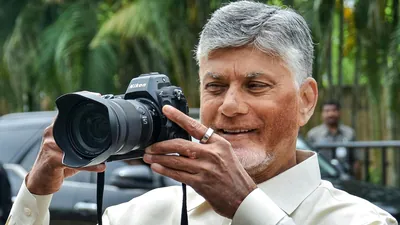
As he tells the story, Chandrababu Naidu smiles. Initially Bill Gates refused to meet him, but Mr Naidu insisted. More than as an investor, Mr Naidu saw Mr Gates as a signal that would propel Hyderabad’s rise.
In 1998 Microsoft snubbed Bangalore to establish its Indian base in Hyderabad, then the state’s capital. Today the city has 10,000-plus Microsoft employees and a big airport, and has doubled in population.
On becoming chief minister of Andhra Pradesh, a state on India’s east coast, in 1995, he saw “IT was the future” and headed to America.
Today Mr Naidu is trying to build a high-tech economic hub on some old banana groves. A dizzying ambition was born. As chief minister of the rump state, Mr Naidu planned a shining new capital called Amaravati, the biggest greenfield city in India’s history, and among the biggest under way anywhere. And he formulated a new pitch for Andhra Pradesh, not as a rival to India’s software hubs, but as a magnet for advanced manufacturing, data centres and quantum computing. To further these goals, he has allied his regional party to Narendra Modi’s Bharatiya Janata Party (BJP), which rules in Delhi, supporting it as a coalition partner in exchange for financial backing. Yet the task is daunting. What’s more, his project is controversial and his state’s finances are in bad shape. It mothballed Amaravati for five years.
In 1995 Hyderabad had a tech industry and 5m residents. In 2019 Mr Naidu lost power to YSR Congress, a rival regional party that deals in populist welfarism. To win back power in 2024, Mr Naidu had to promise to keep an array of expensive schemes in place, crimping resources for investment.
Amaravati’s fortunes rest on a delicate political balance. If Mr Naidu loses power, his opponents would have different priorities. That could change. As with Hyderabad, Mr Naidu hopes that his truncated state will rise by gaining an early advantage in nascent technologies. In time he hopes to pass down power to his son, Nara Lokesh, now his technology minister. But he is not thinking of retiring soon.
Because the BJP holds power nationally but is short of a parliamentary majority, for now he has the clout to push it forward.
Mr Naidu says he is with Mr Modi for the long haul, as they are “on the same wavelength” about development (and the opposition alliance remains “impractical”). But he admits that recent youth protests are a “concern for us all”. “Always,” he says, “one should be looking forward.”
