

The comparison is instructive, though hardly comforting. At his last Air Force Day press conference on October 3, Air Chief Marshal AP Singh was typically forthright. The service presently operates some 30 fighter squadrons of varying vintages, against a government-sanctioned strength of 42. The IAF today is smaller than at any point since 1962 – the last time India lost a war. In 1962, the IAF had roughly 440 aircraft. The PAF had about 200, and the PLAAF about 2,300, of which perhaps 300-400 could realistically be brought to bear on India given the infrastructure and logistics on the Tibetan plateau, and the three air arms flew broadly contemporary machines. That meant a 2:1 numerical advantage over Pakistan and local parity with China.
He said that the IAF needs about two new squadrons of fighters a year just to arrest the decline in its combat mass.
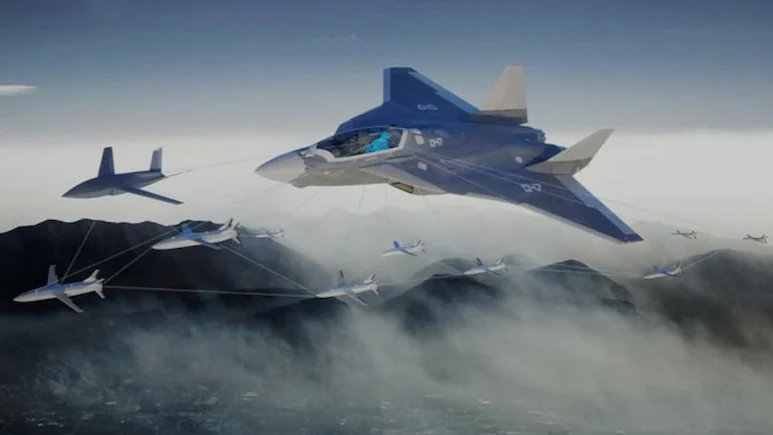
The Collaborative Combat Aircraft (CCA) addresses both. Flown alongside a crewed 4th-generation fighter, it extends sensor and weapons reach, and it can act as a forward line that closes the distance to an enemy fifth-generation aircraft on terms the manned jet couldn’t manage alone. It makes a Su-30MKI or Rafale more competitive against stealth, and it adds airframes in a way no near-term manned programme can. The catch, as always, is time. A CCA programme only works as a hedge if it delivers within years. If India spends a decade reinventing the wheel, the PLAAF and PAF will have moved on again. The numbers, of course, provide an incomplete picture. And can India build them at the rate required? No Indian aerospace programme has ever run at the rate this implies, and it would likely require multiple production lines and private-sector participation from the outset. CCAs will not replace the manned jets the IAF needs, and at the required capability, they are not exactly cheap. But a commitment now can add reach and survivability at a cost the IAF can absorb, if India commits to building them at a pace it has never attempted. As with every policy suggestion for the IAF’s numerical woes, the window to take action is constantly narrowing.
Assuming a 60 per cent serviceability rate across roughly 550 manned aircraft gives about 330 available on a typical fighting day. Pair each with a CCA and your total requirement is around 330 airframes, plus reserves. At a unit cost of $25 million for high-end autonomous CCAs capable of reconnaissance, strike, and air combat, that is an $8.3 billion acquisition, or about Rs 80,000 crore. Compress it into a five-year run, since a longer one forfeits the time advantage, and the bill is $1.6 billion a year. That is about a quarter of the IAF’s annual capital budget, which is about $6.6 billion. Sensors and weapons will add cost, and even a penny-pinching MOD will have to fund at least some 600 air-to-air missiles and a similar number of stand-off weapons for these aircraft. Fielding 330 airframes in five years means 66 a year. HAL is slated to build the far less sophisticated HTT-40 basic trainer at 20 units a year.
Air Chief Marshal AP Singh is right when he says “technology delayed is technology denied.
