
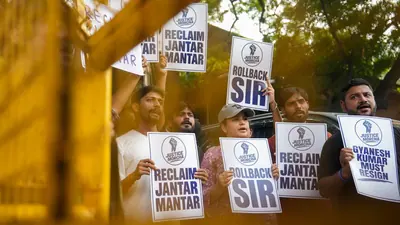
Vinay Sreenivasa spent three years fighting the restriction of protests in Bengaluru to a single, low-visibility ground: Freedom Park, the site of a former central jail in Gandhi Nagar. So, when flash protests erupted across Delhi last week — small groups marching through Connaught Place, Sansad Marg and Dilli Haat INA, with some even attempting to reclaim the barricaded stretch of Jantar Mantar after it was denotified as a designated site — the lawyer-activist who runs the Campaign for the Right to Protest recognised the pattern.
In Bengaluru, the restrictions came in stages. When it disposed of the petition in August, it directed the authorities to enforce the police order. The restriction originated in the police order, not a final judicial ban on protests elsewhere. “But, that was not the order of the court. The same logic of concentration and containment is visible across urban India. “Part of what a protest does is to make the familiar strange — to make us stop, pay attention, and realise something is not what it is meant to be. That act of seeing, hearing, walking, and confronting is where protests make meaning: to make a citizen ask, ‘What are they fighting for?’ and to force a state to ask, ‘What are they asking of me?’” Cities in India, as elsewhere, have almost never formally provided for spaces of protest in their master plans. “It can be used for equity and a more open sense of publicness, but also to impose control and order. It is the language of the state, and so usually the latter win out. Indian cities still carry strong legacies of colonial planning — we, ironically, police our own people the way colonisers once sought to contain natives,” he added. AK Jain, former commissioner (planning) at the Delhi Development Authority (DDA), made an institutional distinction. “These open spaces are marked in the plan. But the decision about where protests will actually be allowed is not a planning decision. “I think it is important to turn this on its head. A protest is not an interruption of life. It is life. It is precisely what fights for all that is precious in life: truth, dignity, fairness, respect, recognition. It does not have to be managed — it has to be welcomed,” he added.
Because the moment a ground was marked for that purpose, it became a political controversy, planners, he added, generally avoided designating specific protest sites. As a result, the right to protest depends largely on police decisions and government orders. Under a 2009 order, protests involving more than 250 people required a licence, but demonstrations were not confined to a single venue. In 2021, after protests disrupted morning traffic, a high court judge wrote to the chief justice, triggering a suo motu public interest litigation. the police commissioner issued a new order, which came into effect in early 2022 and restricted protests to Freedom Park While the case was pending. In March 2022, the high court issued an interim order confining protests to Freedom Park. The Master Plan, from the first plan of 1962 onwards, had reserved 20% of land for greenery and open space, he pointed out.
But Sreenivasa said the police had since treated the interim order as a blanket prohibition on protests at other locations. “Now, any time anybody tries to organise a protest outside Freedom Park, the police keep quoting the interim order of the high court, and say you can protest only in Freedom Park,” he said. “It is a defence, an attempt to turn away, an attempt to evade accountability, to not listen,” said Gautam Bhan, an urban researcher and writer. “Planning has a history of spatial control,” Bhan noted. It is a law-and-order decision taken by the police,” he said. “A very common word that people use for protest is that it is an ‘interruption’ or ‘disruption’ that has to be managed,” Bhan said.
