
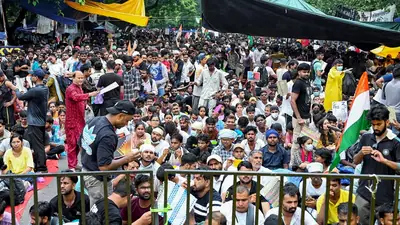
Delhi Police commissioner Anurag Kumar has defended the denial of permission for the Cockroach Janta Party (CJP)’s October 10 march and the preventive detention of protesters as “proportionate to the legitimate objective of maintaining law and order and preventing harm to persons and property”, asserting that the police administration could not have allowed breach of public order by an organisation with a recent history of mob violence, destruction of properties and incidents causing injuries to several people.
The affidavit has relied on communications and public statements attributed to CJP, including calls issued in the days leading up to October 10, to argue that the proposed mobilisation posed a law-and-order challenge.
It has also cited material relating to an earlier “Chalo Sansad” march held on July 20 as part of its account of the organisation’s background and past conduct.
‘No police administration can permit any breach of public order’
The commissioner sought to justify the restrictions by citing what he describes as CJP’s repeated disregard of police directions and the conditions imposed for public demonstrations. The police claimed these gatherings choked central Delhi for hours, leaving students and other commuters stranded in traffic and causing some to miss trains and flights. The Railways has maintained that the decisions were taken in response to the prevailing law-and-order situation. Its account forms part of the government’s broader defence of the measures adopted around the protest.
The affidavit says the organisation had given a written undertaking for an earlier protest in June, including assurances that the gathering would remain peaceful, would not exceed 1,000 participants and would not turn into a march towards Parliament without prior permission. The police alleged that the undertaking was subsequently breached and that the organisation later mobilised people for an unauthorised march towards Parliament on July 20. These allegations concerning the July event led to the police’s decision to deny permission for the October 10 mobilisation, according to the affidavit. The commissioner has also relied on a series of mobilisations on October 6, 7 and 8, alleging they created serious public-order problems in central Delhi. The protests included a march to the office of the Election Commission of India on October 6, a march from Janpath to Jantar Mantar the following day, and another from the Outer Circle of Connaught Place towards Rajghat on October 8, according to the affidavit. On the detentions on October 10, the commissioner said the measures were based on intelligence inputs and an assessment of the prevailing, changing situation. The affidavit said the police invoked Section 65 of the Delhi Police Act, a provision concerning the removal of persons who resist, refuse or disregard lawful directions, at locations where prohibitory orders under Section 163 of the Bharatiya Nagarik Suraksha Sanhita were in force.
Home secretary apologises, defends internet suspension
The suspension was imposed from 10pm on October 9 until 10pm on October 10 within a four-kilometre radius of Raisina Hill, the affidavit said, adding that wi-fi and broadband services were not suspended. Mohan has sought discharge of the contempt notice and modification of the Supreme Court’s October 11 order to permit internet suspensions in situations of necessity, subject to the law and applicable safeguards.
