
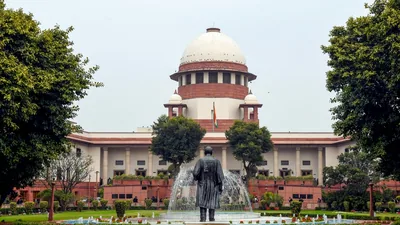
A peon’s 11-year wait for pension has shaken up Uttar Pradesh’s bureaucracy and judiciary, with the Supreme Court directing the state’s chief secretary to put in place a mechanism to ensure that pension papers are not delayed “even by a day”.
Reading through the records, the bench said it was “shocked” to find that for nearly a decade after his superannuation, “for no fault of the petitioner”, he had not been paid his retiral dues. The court said it ordinarily would not interfere with an order merely fixing a date, but did so because the matter concerned Tripathi’s “livelihood” and “dignity”.
The court also directed the chief secretary to issue necessary orders or standard operating procedures, if not already in place, to ensure that pension papers of employees legitimately entitled to their dues are not delayed. But the case remained pending for years. The matter was not listed thereafter.
A bench of justices KV Viswanathan and Arun Palli, which also asked the Allahabad High Court to consider fast-tracking all pension cases, issued the directions after being confronted with the case of Jagdish Prasad Tripathi, who retired as a peon in 2016 after 32 years of unblemished service but was left without his legitimate retiral dues for nearly 11 years. Tripathi was appointed as a peon at Jan Sevak Uchchattar Madhyamik Vidyalaya in Sultanpur in 1984 and retired on July 31, 2016. Despite repeatedly seeking release of his pension, he was forced to approach the Allahabad high court in August 2018. An order in April 2024 directed the high court registry to trace a counter-affidavit filed by the state and place it on record. Even an application filed by Tripathi in October 2025 seeking early disposal was eventually disposed of in April 2026 without fixing a date for hearing.
What happened to Tripathi, the bench said, was an “unfortunate calamity” that should not befall any other employee. It directed the chief secretary to submit by December 31 a report explaining why his pension papers were not cleared immediately after retirement, identifying the officials responsible for the delay, detailing proposed action against them, and explaining how the state proposed to compensate him for the “serious violation” of his rights and “grave injustice”.
