
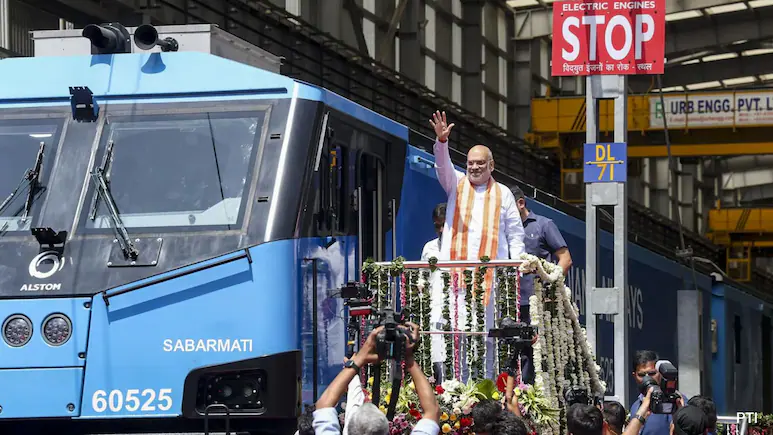
India’s first LNG-powered train was flagged off from Sabarmati on Sunday by Union Home and Cooperation Minister Amit Shah and Gujarat Chief Minister Bhupendra Patel, marking the introduction of LNG as an alternative fuel for railway operations in the country.
The initiative is aimed at reducing dependence on conventional diesel fuel and promoting the use of alternative energy sources in railway operations. Earlier reporting noted: Amit Shah flags off 1st LNG train, says railways to achieve 100% electrification soon Union home minister Amit Shah on Sunday said Indian Railways would soon achieve 100% electrification of its network, a level he said only Sweden has achieved on a much smaller railway system, as he flagged off the country’s first LNG-powered train at Sabarmati Railway Station in Ahmedabad and inaugurated railway development works. Earlier reporting noted: Speaking at an event where he inaugurated projects worth ₹ 1,472 crore, Shah said railway electrification stood at only 30% before Prime Minister Narendra Modi assumed office, while the remaining 70% was completed during his tenure. He said that under the Modi government, the railway safety budget has increased by 67%, while locomotive production capacity has increased by 66%. Earlier reporting noted: “Electrification covered just 75 kilometres in an entire year in 2010-11, whereas 7,188 kilometres were electrified in a single year in 2023-24. Today, 99.6% of the railway network is electrified and we will soon complete the remaining 0.4% as well,” he said.
The use of LNG is expected to reduce fuel expenditure and emissions, including carbon dioxide, nitrogen oxides and particulate matter, according to trial data released by the Railways. The launch was part of a series of railway projects inaugurated and launched during HM Shah’s visit to Ahmedabad. The train uses a diesel-plus-LNG dual-fuel system developed for its Driving Power Cars (DPCs). The dual-fuel system allows the engine to switch between LNG and diesel depending on fuel availability, providing operational flexibility. The system has been designed to retain the power and operational capability of the conventional diesel engine while enabling partial substitution of diesel with LNG. The programme also included the commissioning of the indigenous Kavach train protection system on the Ahmedabad-Palanpur and Ahmedabad-Samakhiyali sections, automatic signalling on two railway sections and the launch of doubling work on the Sabarmati-Sarkhej section. The LNG train launch marks another step by the Railways towards using alternative fuels in its operations, with the technology being tested for its potential to reduce fuel consumption and operating costs while maintaining train performance. (Except for the headline, this story has not been edited by NDTV staff and is published from a syndicated feed.)
Two 1,400 HP DPCs at the Sabarmati Integrated Coaching Depot have been converted to the dual-fuel system, allowing LNG to be used alongside diesel. More than 2,000 km of field trials have been completed on the two converted DPCs to assess the performance and reliability of the technology. Under the system, LNG can replace up to around 40 per cent of diesel consumption. The earlier railway assessment estimated annual savings of around Rs 11.9 lakh from one DPC and around Rs 23.9 lakh from an eight-coach rake. Each converted DPC has an LNG tank with a capacity of around 2,200 litres, capable of holding approximately 850-900 kg of usable LNG. A full LNG fill is expected to provide sufficient fuel for around 1,600 km of operation, reducing the need for frequent refuelling. The package includes projects worth more than Rs 1,542 crore covering railway safety, signalling, line capacity and freight infrastructure. Earlier in the day, HM Shah inaugurated the Rs 700-crore WAG-12 locomotive maintenance shed at Sabarmati and flagged off a WAG-12 electric locomotive.
