
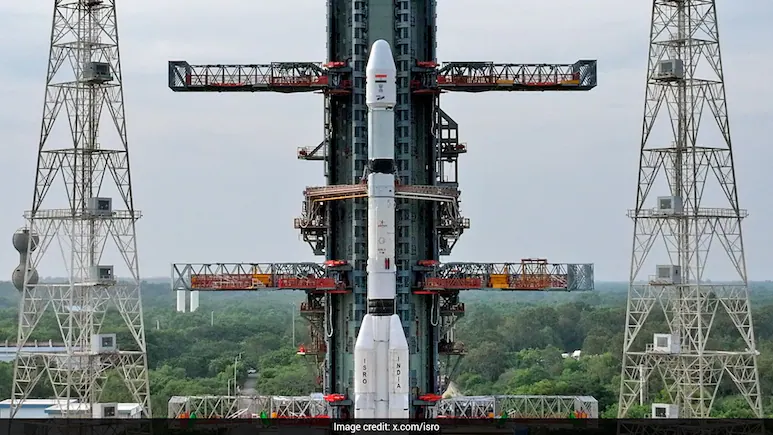
The Indian Space Research Organisation (ISRO) is set to launch India’s next-generation navigation satellite, NVS-03, today, using the Geosynchronous Satellite Launch Vehicle (GSLV), a ‘naughty boy’ now dubbed the ‘smart boy’.
Why NVS-03 Is Important
Eleven satellites have been launched for the NAvIC constellation so far, but failures of payloads and especially atomic clocks have reduced operational capability. It has launched major communications satellites, weather satellites and navigation spacecraft. Yet the incomplete condition of the NavIC constellation remained a concern. The setback has been severe. India ideally requires a minimum of seven functioning navigation satellites for seamless regional coverage. At various points, only a handful remained fully operational. Industry and strategic experts have frequently described this as one of the weakest links in India’s otherwise impressive space infrastructure. The new spacecraft is designed to augment the existing constellation and bring greater robustness and reliability. The indigenous clock represents an important technological milestone. Even a tiny timing error can translate into large positioning errors on the ground. Failures of imported rubidium atomic clocks became one of the most discussed challenges in the NavIC program. Those problems prompted Indian scientists to develop indigenous capabilities. This wide coverage zone includes the Indian Ocean region, making the system strategically important for civilian transportation, fisheries, shipping, aviation, disaster management and military operations. The system provides two categories of service. One is the Standard Positioning Service available for civilian users. The other is a more restricted service intended for authorised strategic and defence users. Accurate navigation has become indispensable in modern warfare where everything from aircraft and drones to missiles and troops depend upon reliable positioning data. The new generation of NVS satellites is also introducing improvements. The addition could improve compatibility with mass-market receivers, smartphones, smartwatches and navigation equipment while broadening adoption of NavIC across civilian sectors. The launch vehicle itself has a significant history. GSLV’s 20th Flight GSLV-F18 marks the twentieth flight of the GSLV program. Over the years, the rocket has evolved from a vehicle plagued by setbacks into a dependable launcher. The program experienced several failures in its early years, particularly while mastering cryogenic propulsion technology. Yet those difficulties eventually led to one of ISRO’s greatest technological successes, the indigenous cryogenic engine program. Its upper cryogenic stage allows it to place heavy satellites into Geosynchronous Transfer Orbit, the destination required for many communications and navigation spacecraft. The GSLV family has become one of ISRO’s most important workhorses. The year has already seen both success and disappointment. Following one successful mission and one failed mission, ISRO will be keen to demonstrate consistency and restore momentum as it works through an ambitious launch schedule. The mission profile remains straightforward. From there, the satellite will use onboard propulsion to reach its final position and begin operational service for the NavIC network. The strategic urgency surrounding NavIC has increased in recent years. Satellite navigation is no longer merely a convenience for map services and vehicle tracking. It underpins military operations, critical infrastructure, banking networks, telecommunications, shipping, aviation and emergency response systems. Any disruption or denial of access can have significant national security implications. India’s policymakers increasingly view space infrastructure as a strategic asset comparable to physical infrastructure on the ground. The country’s experience after the Kargil conflict and the continuing security challenges in the region have reinforced the importance of independent sovereign capabilities. Additional satellites are already in the pipeline. Together they are intended to rebuild redundancy, strengthen coverage and restore the full capability of the constellation. A navigation system requires not only operational satellites but also backup capacity to ensure uninterrupted service when individual spacecraft age, fail or need replacement. For India, the objective is straightforward: create a resilient, sovereign navigation network that remains available regardless of international political circumstances or access restrictions. It is the latest step in an effort that began after the Kargil War, suffered repeated technical setbacks, faced atomic clock failures and years of delays, yet continued through persistence and technological innovation. It will help repair a critical gap in India’s strategic architecture, strengthen the country’s indigenous navigation capabilities and move NavIC closer to the robust operational constellation that India has sought for more than two decades. The satellite carries an indigenous Rubidium atomic clock developed by the Space Applications Centre and will transmit signals in the L1, L5, and S bands. The inclusion of the L1 band ensures compatibility with modern civilian smartphone chipsets and wearable devices.
Because of a series of satellite failures, despite years of effort and significant investment, the indigenous navigation system had not reached its full potential. Because positioning accuracy depends on extremely precise timing measurements, atomic clocks are the heart of any navigation system. The use of a domestically developed atomic clock on NVS-03 is therefore a major technological achievement and could enhance long-term reliability. Because l1 is widely used by commercial navigation devices across the world, this is important. The coming launch therefore represents an important milestone in India’s strategic space journey.
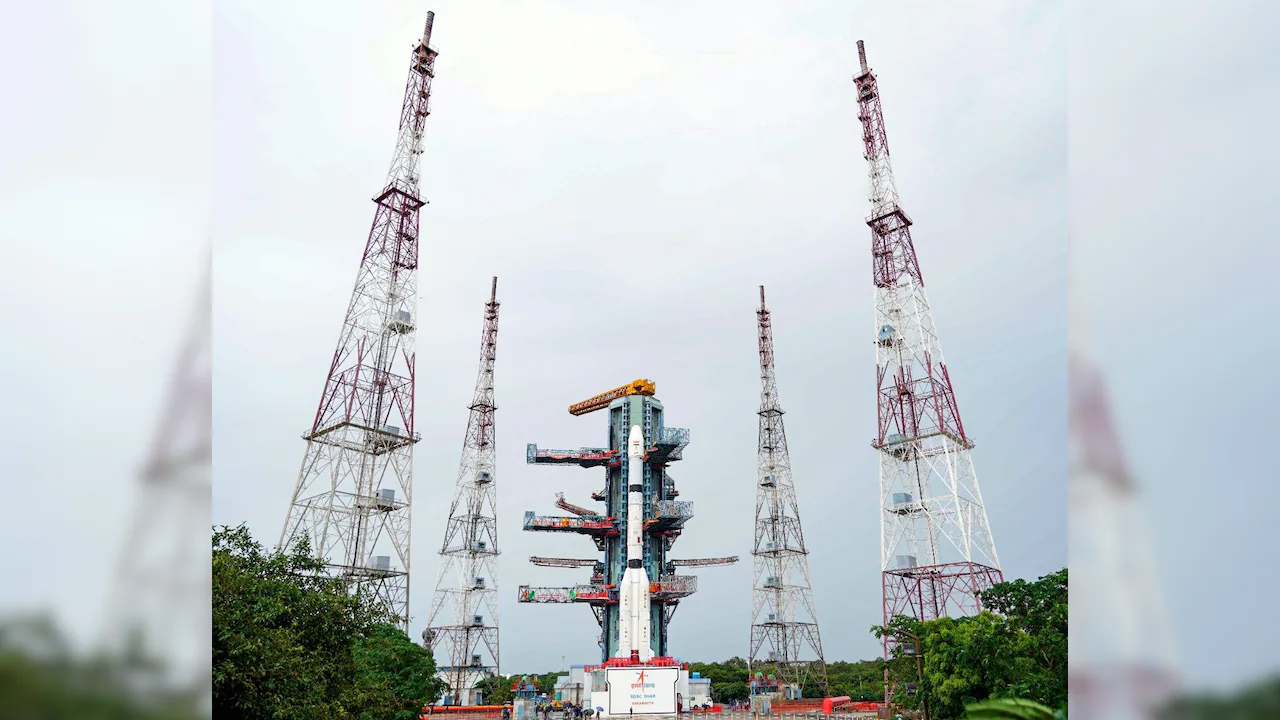
The GSLV-F18 rocket is scheduled to lift off at 11.51 pm from the second launch pad at the Satish Dhawan Space Centre (SDSC-SHAR) in Andhra Pradesh’s Sriharikota. The need for a robust sovereign navigation capability has again come into sharp focus during Operation Sindoor, which was launched on May 7, 2025. India reportedly deployed more than 50 satellites from its extensive space-based assets to support surveillance, communications, reconnaissance, weather monitoring and strategic operations. That is why the launch of NVS-03 carries significance far beyond a routine satellite deployment. NavIC is designed to provide highly accurate Position, Navigation and Timing (PNT) services over India and an area extending approximately 1,500 kilometres beyond the country’s landmass. NVS-03 carries the new L1 signal in addition to the existing L5 and S-band signals. GSLV-F18 seen at the Satish Dhawan Space Centre (SDSC-SHAR) launchpad Photo Credit: ANI Standing about 50 metres tall and weighing roughly 420 tonnes at liftoff, the three-stage rocket combines solid, liquid and cryogenic propulsion systems. More recently, variants of the rocket family have also supported landmark international missions including the launch of the NASA-ISRO Synthetic Aperture Radar, or NISAR, mission, one of the most sophisticated Earth observation collaborations ever undertaken between India and the United States costing $ 1.3 billion. For ISRO, the NVS-03 launch is also important from an organisational perspective. It will be the space agency’s third launch of 2026. GSLV-F18 will lift off from the Second Launch Pad at the Satish Dhawan Space Centre in Sriharikota and place the 2,250-kilogram NVS-03 satellite into Geosynchronous Transfer Orbit after its 20-minute flight. That is why NVS-03 is not expected to be a standalone fix. NVS-04 and NVS-05 are expected to follow in subsequent launches. If successful, NVS-03 will not merely add another satellite to orbit. Earlier reporting noted: The Geosynchronous Satellite Launch Vehicle carrying on board the GSLV-F18 rocket is scheduled to lift off at 11.51 p.m. on Friday (October 30, 2026) from the second launch pad at the Satish Dhawan Space Centre (SDSC-SHAR). Earlier reporting noted: In an unprecedented engineering configuration cleared during the Mission Readiness Review (MRR), ISRO will fly the NVS-03 satellite with its pyrotechnic (pyro) valves already open. This major departure from standard safety protocols — which usually isolate spacecraft propellant during the intense vibrations of liftoff — is specifically designed to bypass the connector failure that stranded the previous NVS-02 mission in January 2025. Earlier reporting noted: NVS-03 is a crucial addition to the Navigation with Indian Constellation (NavIC) system.
ISRO says the satellite carries an indigenous atomic clock along with procured atomic clocks.
Some of India’s earlier navigation satellites suffered atomic clock problems, significantly affecting system performance.
The launch also comes at a time when India is seeking greater strategic autonomy in an increasingly uncertain geopolitical environment. The satellite is the third in the series of second-generation navigation satellites and the twelfth satellite in the Indian Regional Navigation Satellite System, also known as IRNSS-1L. During that conflict with Pakistan, India realised the strategic vulnerability of depending on foreign navigation systems. Access to high-quality GPS information was restricted, highlighting the need for an independent capability. The lesson was simple and enduring. A major power cannot depend entirely on another country’s satellites for critical military and strategic operations. Nearly three decades later, that lesson still remains relevant.
NavIC, short for Navigation with Indian Constellation, was conceived after the 1999 Kargil War.
ISRO says the satellite will provide continuity to navigation services and strengthen the existing NavIC constellation, India’s answer to the American GPS, Russian GLONASS, European Galileo and Chinese BeiDou systems.
The key mission will strengthen the country’s indigenous NavIC, or the navigation constellation, a ‘swadeshi’ GPS of sorts. The launch will place the next-generation satellite into Geosynchronous Transfer Orbit, boosting India’s capability to provide accurate positioning, navigation and timing services across the country and beyond when it reaches its home in space. Equipped with an indigenous atomic clock and new-generation capabilities, NVS-03 will strengthen India’s strategic space architecture and help restore the country’s long-delayed and occasionally hobbled ‘swadeshi’ GPS constellation.
With several NavIC satellites having failed over the years, the launch comes at a critical time as Operation Sindoor — India’s precision air strikes on nine terror infrastructures in Pakistan and Pakistan-occupied Kashmir in response to the Pahalgam terror attack last year — underscored the need for a reliable sovereign navigation network.
