
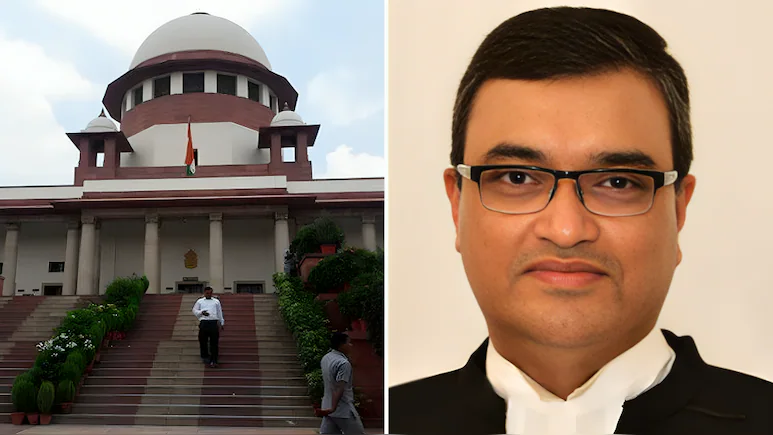
During a hearing on whether the 2023 law on the appointments is free of government influence, he said there was scope for doubt, as the three-member selection committee includes the Prime Minister and a minister nominated by the PM, besides the Leader of the Opposition (Lok Sabha) or LOP.
Justice Dipankar Datta of the Supreme Court used a cricket analogy on Wednesday to make a point about who should, and who should not, appoint the “umpire” — in this case, the Election Commissioners.
On whether the 2023 law on ECI appointments is free of government influence, Justice Dipankar Datta said there was scope for doubt, as the 3-member committee includes PM and a minister nominated by the PM, besides Leader of Opposition.
This nominated-minister provision came in as the Narendra Modi government made a new law to replace the Chief Justice of India on the panel. This was an interim arrangement, to last until Parliament enacted a law. That law removed the CJI and placed a minister instead.
It also asked whether the Leader of Opposition had any meaningful role when the government side could command a 2:1 majority on the panel. He said the principles of that 2023 judgment needed to be applied in any case. In March 2023, the Constitution Bench directed that the President appoint the CEC and ECs on the recommendation of a committee of the Prime Minister, the Leader of Opposition in the Lok Sabha and the CJI.
Justice Datta noted that the Anoop Baranwal judgment said the committee of the PM, LOP and CJI was “transient in nature” and was to operate only until Parliament enacted a law. “If the Constitution Bench intended for the inclusion of the CJI in the selection committee to be binding, it would have said so,” he said, though he pointed towards apparent issues with the law made thereafter.
During earlier hearings, the court had questioned the absence of an independent member on the committee.
“In such a circumstance, the inclusion of a Cabinet Minister in the selection committee fails to provide the independent counterweight that a neutral selector could, and the Cabinet Minister would merely echo the voice of his leader, and consequently, the presence of the Leader of Opposition in the selection committee becomes largely ornamental, without furthering the purpose of his inclusion,” he added.
“The minister nominated by the Prime Minister to function as the third member of the selection committee, chaired by the Prime Minister, cannot be expected to defy his own nominator and risk his continuation as such nominated member on the committee for all practical purposes.
Even otherwise, the collective responsibility doctrine would preclude the minister [from opposing] his Prime Minister,” Justice Datta said.
