
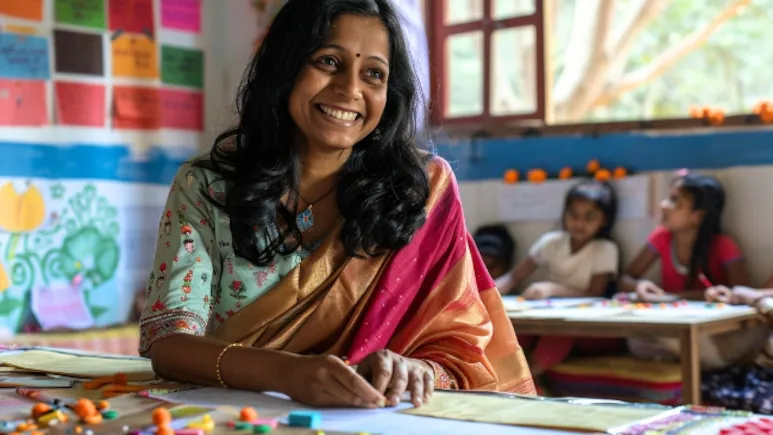
New Delhi: Ayesha Ma’am, a single-teacher educator, recently shared her experiences at the Voices of Teaching event, highlighting the unique challenges faced by the 1,00,843 single-teacher educators across India this year. Despite managing multiple grades, subjects, and administrative tasks alone, she engages her students in creative ways. Each morning, she asks her children how they would like to be greeted, turning attendance into an interactive activity. When a child appears distressed, she employs storytelling and circle time to create a safe environment for them to express their feelings. Ayesha noted that she had never shared her story before, not because it lacked significance, but because no one had asked her to do so.
In a school in Gular, Pramod Sir noticed that caste and social divisions were shaping where children sat, ate and played. He began sitting with the children at lunch, building more group work into the day. Lavina Ma’am noticed something else. Parents were skipping parent-teacher meetings that had narrowed to a recitation of marks and deficiencies. She rebuilt the meetings around a child’s strengths instead — how they had grown, helped a classmate, contributed to the class. Attendance came back. None of this reached Pramod Sir or Lavina Ma’am through a training manual. It came from paying close attention to their own classrooms. And for a long time, that is where it stayed…inside one classroom, known to one teacher. These teachers are not implementing education. They are observing, experimenting, solving problems and producing knowledge. Together, these examples ask us to reconsider what counts as educational innovation. It is not only a new device, platform or centrally designed programme. It can be a parent meeting rebuilt around a child’s strengths. It can be a story that helps a frightened child speak. This Teachers’ Day, we could ask teachers three questions: What have you tried in your classroom? What did you learn from it? What would help you take it further? But the truest version of that question isn’t ours to ask at all. It’s the one teacher already asking another, in a staffroom, at a workshop, across a lunch table, long before anyone with a title shows up to write it down. What made that possible wasn’t a policy. It was another teacher, sitting in the audience, ready to hear it. (About the Author: Deepika Mogilishetty is the Chief, Policy & Partnerships for EkStep Foundation. She leads the foundation’s work on early years leveraging the power of networks and narratives to bring focus and attention to the growth and development of children in the early years.)
It can be a teacher reorganising lunch so that children cross social lines.
Ayesha answered all three the day she stood up and told a room what she does every morning before her children arrive.
Over time, children from different communities began eating together, working together, questioning barriers they had earlier accepted.
Voices of Teaching, which brought together educators from Uttarakhand, Delhi, Karnataka, Chhattisgarh and Maharashtra, was an attempt to capture this educational innovation. that. The teachers were not there to be trained. Ayesha found her circle-time practice sitting next to Lavina’s parent meetings and Pramod’s lunch table, and recognised in them the same instinct she’d never had a name for. The Dhwani toolkit works on that same principle. It wasn’t designed in an office and handed down — it was built from the lived experience of teachers across government schools, private schools, Montessori environments and nonprofit settings, the way Voices of Teaching was built from a room full of them talking. None of this is easy to keep doing. She teaches alone, several grades at once, with no one down the hall to ask when something isn’t working. That is exactly why rooms like Voices of Teaching matter as much as they do — they are, for many teachers, the only place all year where someone else in the same position is listening.
Because it’s shared freely, what Pramod discovered at a lunch table in Gular can reach a teacher in Chhattisgarh without waiting for a scheme to carry it there — it only needs another teacher willing to try it. Only 58.2% of India’s schools have ramps with handrails, which means teachers like Ayesha are asked to build inclusion inside buildings that aren’t built for it.
They became, for each other, a “living library”, trading what they had each figured out alone, in rooms hundreds of kilometres apart, for problems that turned out not to be so different after all. That is the only mechanism that seems to actually work: not a teacher being told what to do, but a teacher hearing another teacher describe a problem she already knows, and realising someone has quietly solved it. Its principles are close to what Ayesha, Pramod and Lavina already do without being told to: support the teacher first, observe rather than diagnose, document and celebrate a child’s growth.
