
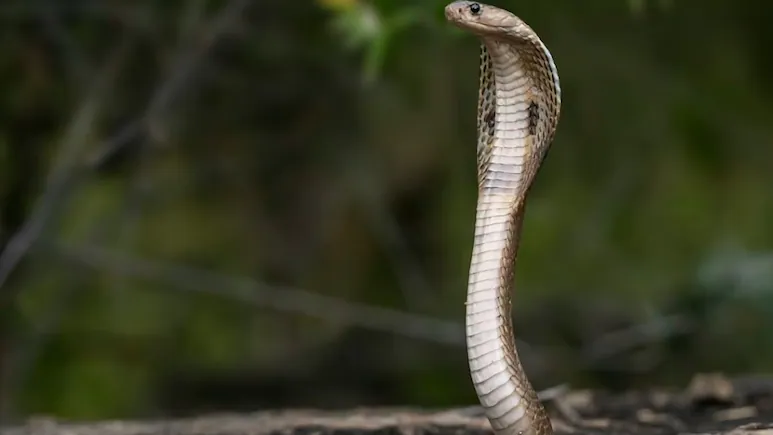
Somewhere inside a Madhya Pradesh forest, a snake slips across a patrol road in the darkness. A forest guard stops, photographs it, records the location and sends the GPS-tagged image for identification. Elsewhere, researchers drive slowly through a forest road after sunset, scanning the ground and undergrowth for movement. In another part of the state, preparations are being made for the next stage attaching radio transmitters to selected snakes to find out where they go after disappearing into the forest.
Madhya Pradesh has around 50 recorded snake species Nine of them are venomous, including the medically important “Big Four”.
Small transmitters can allow scientists to follow individual snakes and study how far they travel, the size of their home ranges, the habitats they prefer and what happens after they are captured and released elsewhere. Except, scientifically, it is not really a census. Instead of attempting the nearly impossible task of counting every snake in the state, Madhya Pradesh has begun what is being described as India’s first extensive snake-specific scientific exercise to study their diversity, distribution, relative abundance and ecology. The project is being conducted by researchers from the Wildlife Institute of India, Dehradun, along with the Madhya Pradesh Forest Department across five protected forest landscapes. Behind what may sound like an unusual forest experiment lies a serious public-health story. The public-health burden has also been rising sharply in official records. Satna and Sagar were among the districts reporting particularly high numbers. The Madhya Pradesh Forest Department’s enormous patrol network has effectively become part of the research system. When forest personnel encounter a snake during routine patrolling, they photograph it and record its location. GPS-tagged photographs are then shared with researchers, who identify the species and add the sighting to a growing distribution database. Snakes are secretive, seasonal and exceptionally difficult to detect. One animal may be observed repeatedly while dozens of others in the same habitat remain hidden. A sighting proves the presence of a species, but not the total population living there. The next phase could provide an even closer look at how venomous snakes actually live. Researchers are expected to use radio telemetry on selected snakes, particularly medically important species. This could have a direct impact on snake-rescue practices.
Madhya Pradesh provides Rs 4 lakh compensation in eligible cases of death due to snakebite. The study began in March 2026 and is expected to continue till the end of 2027. Madhya Pradesh has around 50 recorded snake species, according to Ujjain-based Sarp Anusandhan Sangthan. Integrated Health Information Program, or IHIP, data recorded 1,208 snakebite cases in Madhya Pradesh in 2022. The number rose to 1,479 in 2023 and then to 3,334 in 2024 almost a three-fold increase in two years. An analysis of Madhya Pradesh government compensation records found 5,779 compensated snakebite deaths between April 2020 and March 2022, with around Rs 231 crore paid to affected families.
This is Madhya Pradesh’s much talked-about “snake census”. Nine of them are venomous, including the medically important “Big Four” — the Indian cobra, common krait, Russell’s viper and saw-scaled viper.
